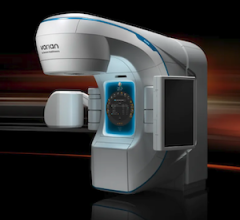
August 7, 2017 — ViewRay Inc. announced that several presentations of early clinical experience with its MRIdian Linac technology were made at the 2017 annual meeting of the American Association of Physicists in Medicine (AAPM), July 30-Aug. 2 in Denver. MRIdian Linac is the world’s only U.S. Food and Drug Administration (FDA)-cleared magnetic resonance imaging (MRI)-guided radiation therapy system with linear accelerator-based delivery, according to the company.
The company's MRIdian System was the focus of 30 abstracts selected by AAPM, including several talks describing the significant advantages of daily on-table adaptive radiation therapy and its positive clinical impact on treatment. MR-guided on-table adaptive therapy allows for dose escalation for stereotactic body radiation therapy (SBRT) treatments and dose de-escalation in cases where the critical structures are too close to the tumor.
The AAPM Scientific Session talks also highlighted MRIdian's fully integrated workflow for adaptive therapy, which incorporates complete Monte Carlo dose replanning to account for changes in the shape and position of the tumor and adjacent organs in less than two minutes.
ViewRay featured a number of presentations in the company's booth given by MRIdian users from five top cancer centers: Henry Ford Health System in Metro Detroit; University of California, Los Angeles; Washington University in St. Louis; University of Wisconsin; and University of Miami.
Highlights from these talks included:
- Carri Glide-Hurst, Ph.D., from Henry Ford presented on their initial patient experience with MRIdian Linac including treatment times of 6.25 minutes for 8Gy SBRT treatments and 5 minutes for prostate intensity modulated radiation therapy (IMRT) treatments. She also showed MRIdian movies on how the system's real-time imaging during treatment automatically detected and paused the treatment when a transient gas bubble shifted the prostate. Additional patients in the queue for Henry Ford include liver SBRT, retroperitoneal SBRT and accelerated partial breast irradiation (APBI). "MRIdian really does take the blindfold off in showing us things we've never seen before," said Glide-Hurst. "We're now able to treat indications that we hadn't really treated previously like APBI. We're excited about the potential of reducing margins and getting a conformal delivery with MRI guidance";
- Anthony Doemer, M.S., from Henry Ford highlighted the ultra-sharp beam characteristics for the RayZR Double focused multileaf collimator (MLC). Because of its design, it removes the need for tongue and grooves, nearly eliminating any leakage through the leaves (average leakage, less than 0.001 percent). "We were able to successfully commission the MLC with great agreement between measured small beam profiles of 0.2 x 0.4 cm and larger profiles matching very well with the Monte Carlo simulations with tight conformance to the beam model," said Doemer;
- Yingli Yang, Ph.D., from UCLA presented on MRIdian's high-quality MRI images, specifically the superior soft-tissue image quality enabled by MRIdian's processing techniques. Yang also highlighted early research imaging results acquired using a new MR acquisition technique reducing the imaging times of 17 seconds down to approximately 12 seconds. This 3-D MRI sequence provides motion artifact-free images with a large field of view (FOV) for short breath hold. She also presented research on a 3-D MRI acquisition scheme that is insensitive to motion and will enable free breathing MRI for patients who are unable to hold their breath;
- Vivian Rodriguez, Ph.D., from Washington University shared their extensive experience with on-table adaptive therapy, illustrating the significant anatomical changes that can take place within a short period of time and highlighting case examples where the treatment plan was reoptimized to escalate or de-escalate dose based upon the proximity of nearby critical structures while the patient was on the treatment table. "With a single button click we can replan within a minute a new treatment plan that reduces dose to organs at risk while giving a greater dose to the target," said Rodriguez; and
- Kathryn Mittauer, Ph.D., from the University of Wisconsin shared their experience personalizing patient treatments through daily dose-guided radiotherapy using online recalculation and evaluation of the actual dose distribution. "We're able to deliver higher doses to targets adjacent to organs at risk due to improved confidence in treatment set up and delivery that would not otherwise be clinically feasible," said Mittauer.
For more information: www.viewray.com
Related Articles on MRI-guided Radiation Therapy:
MRI-guided Radiation Therapy (2017)
First Patients Treated with ViewRay's MRIdian Linac at Henry Ford Health System
Elekta Begins MR-Linac Installation at Sunnybrook Health Sciences Centre
MRI-Guided Radiation Therapy (2016)

 October 07, 2026