Source: www.aapm.org
July 23, 2007 - By borrowing techniques used in telecommunications technology, computed tomography (CT) scanners may eventually see data collection speeds increase by hundreds of times, leading to better images, faster imaging procedures, and potentially lower X-ray exposures. A University of North Carolina team has pioneered a method that collects images from many sources at once, instead of the current serial method of data collection.
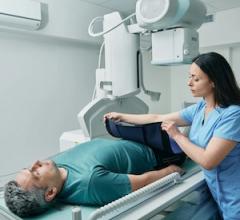
Modern CT scanners, widely used for diagnostic medical imaging and security screening, collect over 1,000 images in less than one second by high-speed rotation of an X-ray tube around the object. However, the data is collected in a serial fashion, essentially one piece of data at a time.
Multiplexing represents an innovative solution for potentially speeding up CT scans. A widely used concept in many communications-related fields, multiplexing is a process of combining multiple signals to form one composite signal for transmission. For the multiplexing CT scanner, multiple X-ray sources fire simultaneously to capture images from multiple views at the same time. In general, a factor of N/2 (N=total number of images) increase in the speed can be achieved using the multiplexing technique. For example, the speed of clinical CT scanners that acquire around 1,000 views per gantry rotation would increase by a factor of 500.
A team from the University of North Carolina, Chapel Hill, has been developing multiplexing CT scanners for several years. The team very recently created a 25-pixel multiplexing CT scanner, but engineering difficulties lie in front of the ultimate goal, a scanner with approximately 1,000 X-ray pixels. According to team leader Jian Zhang, the cost of these machines would not rise significantly, as new technology enables hundreds of X-ray cathodes to be fabricated on a single silicon wafer.
For more information: www.unc.edu, www.aapm.org

 October 07, 2026