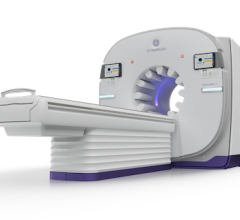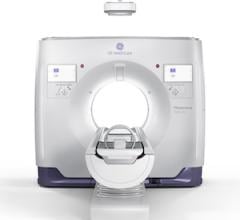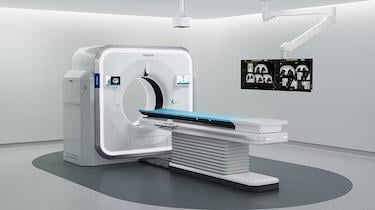
With an 85 cm bore, Rembra accommodates challenging patient types, providing more access for complex interventions, bariatric imaging and trauma, helping improve patent comfort and may reduce the need for rescans. (Photo: Philips)
March 5, 2026 — At ECR 2026, Royal Philips introduced Rembra, its next-generation radiology CT system designed for the realities of acute and high-demand imaging3.
Healthcare systems worldwide are under unprecedented pressure. Rising patient volumes, increasing clinical complexity and workforce shortages are pushing frontline, high-acuity and high-demand imaging to its limits. Rembra was engineered from the ground up to meet these challenges, bringing together advanced detector technology, ultra-fast scan and reconstruction speeds and streamlined workflows in a system built for speed, consistency and long-term value.
“Rembra is built for the realities that clinicians face every day,” said Dan Xu, Business Leader for Computed Tomography at Philips. “By combining our most advanced detector technology with AI-powered workflows and industry-leading speed, Rembra represents a significant step forward for high-acuity imaging, delivering speed, access and diagnostic confidence when it matters most.”
Speed to Support Timely Clinical Decisions
In emergency, trauma and other high-demand settings, delays in image reconstruction can slow diagnosis and impact outcomes. Rembra addresses this challenge with a reconstruction speed of up to 106 images per second1. This speed is designed to help radiologists and clinicians access images quickly in stroke, trauma and other urgent cases. It may support smoother workflows and timely clinical decisions in busy emergency departments.
Designed for high-demand environments, Rembra can support 270 exams per day2, helping imaging departments manage growing volumes without compromising speed or confidence.
Optimized Patient Positioning
With a 85 cm bore, Rembra is designed to help facilitate patient access and positioning, and may help improve comfort for trauma, bariatric and interventional cases.
Rembra features a 60 cm standard field of view (sFOV) and an 85 cm extended field of view (eFOV), both the largest in their class of frontline radiology CT systems4, enabling full anatomical visualization in a single scan. Rembra also features a high-performance patient table with Philips’ best-in-class scan range of up to 2.3 meters and gantry-to-tablespace of 46 cm to support flexible patient positioning.
“In interventional and high acuity settings, precise access and efficient positioning are essential,” said Professor Olivier Rouvière, MD, PhD, Head of Department at Hospices Civils de Lyon (Centre Hospitalier Universitaire de Lyon). “Rembra’s 85 cm bore supports improved access as well as faster and safer positioning of long needles and instruments in complex procedures.”
Clinical Performance
At the heart of Rembra is Philips’ newest NanoPanel Precise XD, a high-density detector designed from the outset to work hand-in-hand with AI. It delivers high dose-efficiency, high-resolution imaging at the source and is designed to support overall image quality and diagnostic confidence.
The detector offers exceptional in-plane spatial resolution of 23 line pairs per cm, enabling sharp detail and visualization of fine anatomical structures down to 0.25 mm. A 2D anti-scatter grid provides strong scatter rejection to help preserve image clarity in challenging patient types, supporting consistently high image quality across patient sizes and clinical scenarios.
Productivity, Predictability and Long-term Value
Integrated AI-enabled smart workflows can help automate routine steps and simplify certain operations. These features are intended to support workflow efficiency for consistent results.
Built for operations at high-altitude environments up to 5000m, Rembra is engineered for reliability, durability and long-term performance, supporting a system lifetime of up to 20 years with required maintenance and upgrades. Philips’ Tube for Life5 service program further enhances cost predictability by covering tube replacement costs for up to 10 years.
Click here to learn more.
Sources
-
Based on publicly available manufacturer specifications for leading radiology CT systems as of March 2026 on reconstruction speed in this class of scanners and bore size.
-
Based on a sixteen-hour day, with throughput testing with 203 patient scans/ 12 hours for Rembra with typical radiological profiles and protocols.
-
Pending 510(k) - not available for sale in the USA
-
The Extended Field of View (EFOV) of 85 cm is intended solely for use in treatment preparation and the planning/simulation of radiation therapy. It cannot be used for diagnostic purposes. The water equivalent material external contour deviation of body system phantom positioned (partially) outside scan FOV with phantom edge adjacent to bore cover shall be within 1mm in terms of mean Hausdorff distance compared to the true external contour.
-
Tube for Life guarantee availability varies by country. Please contact your local Philips sales representative for details

Additional information on Philips
- Neonatal MRI System Granted FDA Clearance
- Philips Enters Agreement to Acquire SpectraWAVE
- Philips Rolls Out Next-Gen Web-based Diagnostic Viewer

 October 07, 2026