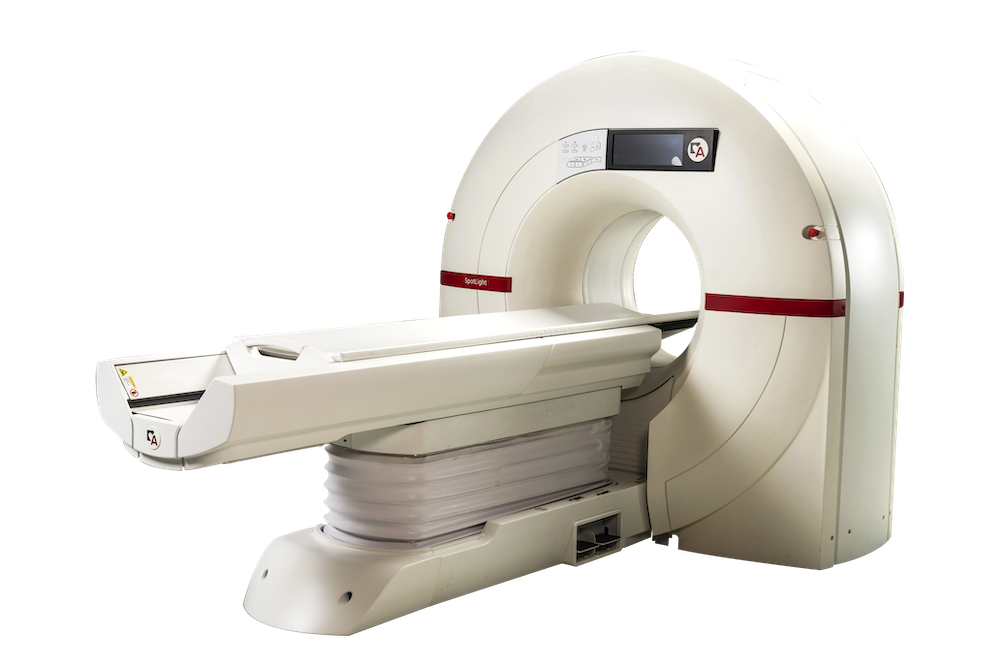
The Arineta SpotLight, a small-footprint cardiovascular CT scanner, is designed for use in office and mobile settings, including ambulatory surgery centers, physician hospitals, and rural and community hospitals. (Photo: Arineta)
Advances in coronary CT angiography (CCTA) have reached the point where image quality and AI capabilities are creating new clinical possibilities.
Take, for example, identifying partial arterial obstructions in asymptomatic patients. A decade ago, a stress test was the preferred method of doing so. “But research in thousands of patients and studies has shown us that it’s about as good as a coin flip in identifying a serious blockage,” says cardiologist Alberto Morales, MD, with South Tampa Cardiology.
Today, CCTA is the first-line treatment, with newer devices like the 560-slice Arineta Spotlight Duo delivering high-definition spatial resolution for more definitive diagnoses. “Cardiac CT enables us to perform specialized, individualized care for people with very low traditional risk factors,” Dr. Morales says. “We can scan them and find out that they have something potentially serious going on that we can aggressively manage—something we weren’t able to do before without invasive strategies.”
Clearer Images Guide AI Detection
When compared with traditional 64-slice CT scanners, Dr. Morales says, dedicated cardiac CT machines produce much clearer images.
“Since we acquired an Arineta scanner about four-and-a-half years ago, the percentage of suboptimal image quality has shrunk dramatically, from anywhere between 5% to 10% down to less than 1%,” he says. “That means 90% to 95% of the images are excellent quality, and another 5% to 7% are very good.”
Clear images, Dr. Morales adds, raise the accuracy of AI tools such as Heartflow, Cleerly and Elucid, which color-code lesions and analyze plaque vulnerability. Combining cardiac CT with AI allows cardiologists to analyze both blockages and the health of the vessel wall.
“When you submit images to AI, if the image is degraded, blurry, or suboptimal, the AI suffers as well, and it can make errors,” Dr. Morales says. “So having good-quality imaging allows the AI to be much more robust and accurate.”
Reduced Radiation Exposure
Dedicated cardiac CT machines use a lower radiation dose than whole-body CT scanners, creating a safer environment for patients and providers. “The radiation is not much more than a mammogram if you watch it very closely,” says cardiologist Jeffrey Boone, MD, with Boone Heart Institute in the Denver area. “Our staff get the millisieverts down to very, very acceptable levels so you can do it more frequently to follow plaque.”
Dr. Morales concurs, noting that his team, “can get radiation down between 1 and 3 millisieverts.”
Expanding Adoption to Improve Outcomes
While small-footprint scanners like the Arineta expand dedicated cardiac CT imaging to cardiology practices and outpatient clinics, hospitals can benefit from the technology, too.
Dr. Boone envisions a scenario where dedicated CT could save millions of dollars in emergency room care for people with chest pain. “You have dedicated CT and AI in there,” he says. “In 30 minutes, the patient is either in or out of the ER, and they’ll know exactly what’s there.”
During the next five to 10 years, Dr. Boone envisions a world where getting a cardiac CT scan will be as common as getting a colonoscopy. “Everybody at age 40, 45, 50 will get one,” he says. “Then you’ll stratify when you get your next one.”
Implications for Other Disease States
Looking further into the future, Dr. Boone also sees a time when the benefits of cardiac CT could extend to other disease states, including neurological conditions like Alzheimer’s and other dementias.
"If you treat what you find in the heart, you’re going to treat the brain, the kidney, and elsewhere,” he says. “We don’t know quite what dementia is, but we know that most everybody with dementia has a ton of plaque in the brain. If we clean out the 30,000 miles of blood vessels in the brain, it’s probably got some good benefit in the 100 billion brain cells that are up there.”

 October 07, 2026