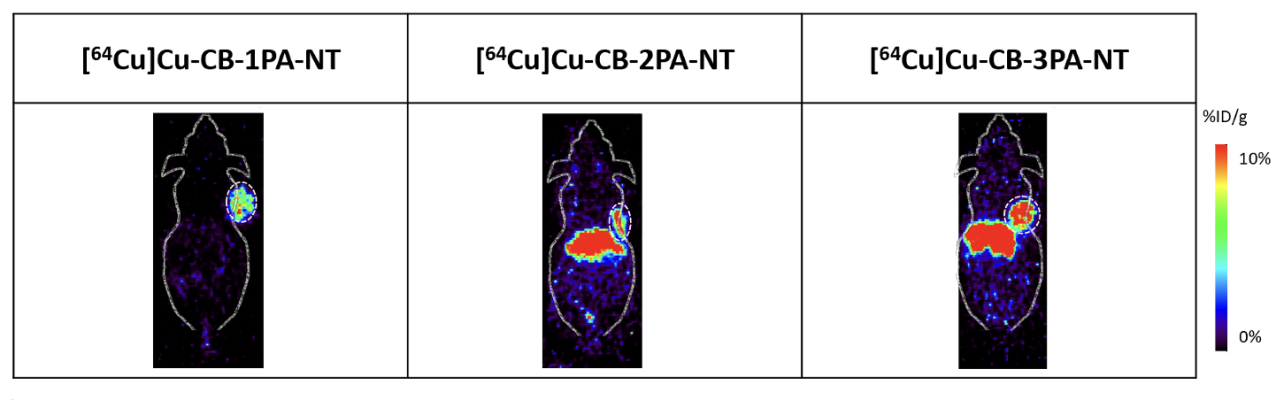
Figure 1. Representative PET image of three leading compounds in H1299 tumor mouse at 24 hours post-injection at 10 %ID/g scale.
June 28, 2023 — A newly discovered radionuclide-based agent (CB-2PA-NT) has been shown to have high tumor uptake, sustained tumor retention, and high contrast in preclinical models, making it a prime candidate for a novel theranostics approach. Targeting the neurotensin receptors (NTSRs) that are present in a variety of cancers, CB-2PA-NT has the potential to significantly expand the scope of precision medicine. This research was presented at the 2023 Society of Nuclear Medicine and Molecular Imaging Annual Meeting.
NTSRs are overexpressed in a variety of cancers, including lung, colorectal, breast, pancreatic and prostate cancers. Recently, several attempts have been made to synthesize radiometal-labeled agents that target the receptor NTSR1. However, most of those attempts have demonstrated only moderate tumor uptake and retention.
“Building on previous research and experience, my colleagues and I discovered that the cross-linked polyamine moiety can greatly improve tumor uptake and maintain high contrast,” said Xinrui Ma, MPH, a doctoral student at the University of North Carolina in Chapel Hill, North Carolina. “In this study we tested a series of NTSR1 antagonists to see which was most useful for imaging and therapy applications.”
A series of NTSR1 antagonists were synthesized with variable propylamine linker length and different chelators (CB, NOTA, and DOTA), and radiolabeling reactions were performed. Western blot was used to determine the NTSR expression in human lung cancer cell lines (H1299). The antagonists’ in vitro and in vivo stability and binding affinity to lung cancer cells were also assessed. Finally, small animal PET/CT imaging was used to evaluate the agents’ biodistribution properties.
NTSR1 was confirmed to have high expression in H1299 cells by western blot. The antagonist CB-2PA-NT showed good binding affinity toward H1299 cells, and small mammal imaging confirmed its prominent tumor uptake, high tumor-to-background contrast and long tumor retention. After comparison with the other NTSR1 antagonists, CB-2PA-NT was identified as the leading agent for further evaluation.
“The success of this theranostic approach has the potential to provide an accurate imaging-based method to efficiently detect NTSR1 expression in multiple types of cancer for diagnosis, patient screening, and treatment monitoring, as well as a radionuclide-based agent for therapy. This will ultimately lead to more personalized medicine for cancer patients,” noted Ma.
To further explore the theranostic potential of this agent for patient management, University of North Carolina researchers have collaborated with the University of Wisconsin, and first-in-human imaging with CB-2PA-NT is expected to begin in the near future after regulatory approval.
For more information: www.snmmi.org
Find more SNMMI23 conference coverage here
 October 19, 2026