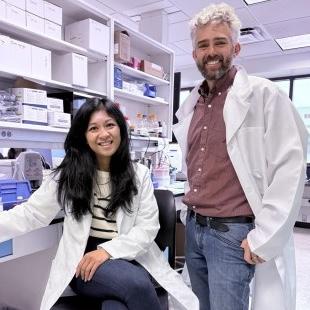
As interdisciplinary collaborators at Wayne State University, School of Medicine's Sheryl Roberts, Ph.D., left, and College of Liberal Arts and Sciences’ Christopher Kelly, Ph.D., are advancing discoveries by merging chemistry and computational science. (Photo: Wayne State University)
Nov. 10, 2025 — Researchers at Wayne State University and the Barbara Ann Karmanos Cancer Institute have developed a chemical imaging probe that resists the breakdown of certain compounds in the body, giving doctors a more dependable way to track, and potentially treat, prostate cancer.
Wayne State School of Medicine Assistant Professor of Oncology Sheryl Roberts, Ph.D., a member of the Karmanos Molecular Therapeutics Program, is the principal investigator on the study.
The National Cancer Institute lists prostate cancer as the most common cancer and the second-leading cause of cancer death among men in the United States. The institute estimates prostate cancer will make up 15.4% of all new cancer cases in 2025.
“Certain hormone receptors in the body can drive cancer growth,” Dr. Roberts said.
Her research focuses broadly on developing tools that either block or eliminate these hormone receptors, including the androgen receptor.
“Many patients develop resistance to current drugs. Being able to track AR (androgen receptor) over time could help doctors choose the right treatment sooner and more effectively,” she said.
Despite three decades of progress, resistance inevitably develops, leading to the progression of castrate-resistant prostate cancer, a lethal stage of the disease. Evidence suggests that restoration of AR signaling, driven by genomic amplification of AR and subsequent overexpression, is a key driver of the progression, per “High-Affinity Probes for Androgen Receptor Imaging: From Cells and In Silico Modeling to Whole-Body Fluorescent Applications,” published in the Journal of Medicinal Chemistry.
ARi-FL is a series of visible- and near-infrared fluorescent AR inhibitors.
“We developed new probes, ARi-FL, that light up AR so it can be seen in cancer cells and tumors. It works robustly, stays stable and can detect AR even with mutations. This tool could help track AR in patients and guide better treatment choices,” Dr. Roberts said.
She is now using computational data, in collaboration with the College of Liberal Arts and Sciences Professor of Physics and Astronomy Christopher Kelly, Ph.D., to fine-tune the chemistry and advance toward radioligand strategies for next-generation probes.
The research was supported by the National Institutes of Health grant DK076629 to Dr. Kelly, and Karmanos Cancer Center Initiative Grant and Wayne State University Start-up ID 221802 award, both to Dr. Roberts.
To learn more about Dr. Roberts’ research, visit imaginglab.org.

 October 07, 2026