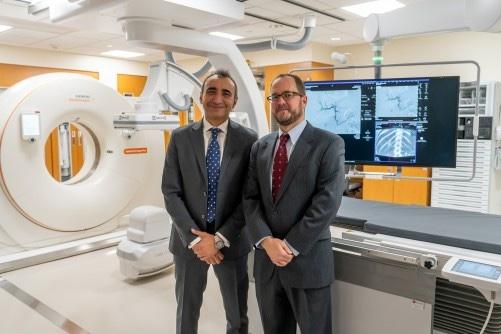
Interventional radiologists Wael Saad, MD, FSIR, and Ziga Cizman, MD, MPH in Huntsman Cancer Institute at the University of Utah's new angio-CT suite, a novel technology that will ease travel burdens for patients across the Mountain West. (Photo: Huntsman Cancer Institute at the University of Utah)
Nov. 12, 2025 — On Nov. 11, Huntsman Cancer Institute at the University of Utah (the U) opened its first specialized angiography-CT suite to enhance treatment options offered in interventional radiology, a field of medicine that uses imaging to conduct minimally invasive procedures. The only one of its kind in the Mountain West, this new technology aims to improve patient outcomes and reduce travel burdens for patients.
“I am thrilled to be able to offer this novel technology in the care of our cancer patients from across the region,” says Sachin Apte, MD, MS, MBA, chief clinical officer and physician-in-chief at Huntsman Cancer Institute and professor of obstetrics and gynecology at the U. “This new angio-CT suite will enable our interventional radiologists to deliver the latest cancer treatments to our patients in need of complex multidisciplinary care and improve the lives of the patients and families we serve.” The suite features two forms of imaging equipment in one dedicated space—one for angiography and the other for CT scans.
Angiography involves injecting X-ray dye into the blood vessels to map out which vessels are feeding a patient’s tumor. This is done under fluoroscopy, a live X-ray visual of the human body. In cancer treatment, angiography is used to either cut off blood supply to the tumor or attack the tumor directly with pinpoint-accurate radiation or chemotherapy through the blood vessels. This targeted approach protects healthy tissue and minimizes side effects associated with infusion and whole-system chemotherapy, like hair loss and nausea.
CT scans are higher-quality still images. Interventional radiologists use CT scans to pass a needle directly into the tumor to freeze or heat the cancerous tissue.
These two procedures are typically performed separately. They can be done on the same day in different rooms, requiring moving patients under anesthesia, or across several appointments, which necessitates more travel time and delayed treatments for patients.
Performing both procedures in one dedicated space will help remove those barriers to care as well as enable interventional radiologists to use imaging combinations more effectively, says Wael Saad, MD, FSIR, interventional radiologist at Huntsman Cancer Institute and director and professor of radiology at the U.
Clinicians will be able to first use a CT scan to map out the best approach to the tumor with the highest quality image, complete the angiography procedure under fluoroscopy, then check to see the results of the procedure in the CT scan again in the same setting.
“Performing these two procedures in the new angio-CT suite allows us to treat our patients with minimal impact on healthy tissue. We can also provide patients with real-time and day-of confirmation of how the treatment worked,” says Saad. “This last step is crucial for our patients who may drive several hours to be here, as they won’t have to return for a follow-up appointment for another scan.”
One appointment for both procedures is both more convenient and safer for patients, as they won’t have to go under anesthesia a second time. These interventional measures are most often used to treat liver and renal cancers, though interventional radiologists can treat across the spectrum of cancer care.
“This cutting-edge technology, the first of its kind in the region, will further enhance the advanced minimally invasive care provided for patients at Huntsman Cancer Institute by our interventional radiology team,” says Charles Ray, MD, PhD, interventional radiologist at Huntsman Cancer Institute and interim chair of the Department of Radiology and Imaging Sciences in the Spencer Fox Eccles School of Medicine at the U. “This is a game changer—one that improves outcomes and allows us to deliver highly targeted therapies with precision. It represents Huntsman Cancer Institute’s next step in our ongoing effort to combine cutting-edge technology with compassionate, patient-centered care.”
 October 09, 2026