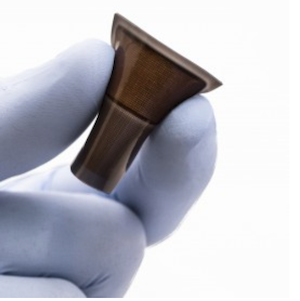
The wearable ultrasound patch is made of soft material that
can be easily bent. Photo: Geonho (Tom) Park/UC San Diego
May 26, 2026 — A soft, wearable ultrasound patch that can continuously monitor a fetus for hours at a time — and it can do so consistently even as the fetus and umbilical cord constantly move during pregnancy — has been created by engineers at the University of California San Diego.
The technology could help doctors detect complications earlier in high-risk pregnancies. In one case during clinical testing, the patch detected prolonged abnormal fetal signals that prompted medical intervention through an early Cesarean delivery, which researchers say may have helped save the baby’s life. The technology could also expand access to prenatal care in low-resource settings, where skilled ultrasound technicians and continuous, long-term monitoring are often limited or unavailable.
The work was published in Nature Biotechnology.
Wearable Ultrasound Technology
“Wearable ultrasound technology has the potential to enable continuous prenatal monitoring and improve pregnancy outcomes in ways that were previously not possible,” said study co-first author Geonho (Tom) Park, a chemical and nano engineering PhD student at the UC San Diego Jacobs School of Engineering. Park co-led the study with fellow UC San Diego Jacobs School of Engineering co-first authors Yizhou Bian, Hao Huang and Sai Zhou.
Currently, most prenatal ultrasounds typically provide only brief snapshots of fetal health and require trained sonographers to operate the equipment. The new wearable ultrasound patch is designed to stay on the body and continuously track a baby’s anatomy and blood flow in real time, without requiring someone to manually guide the ultrasound probe.
“To comprehensively monitor mothers and babies over the amount of time needed to catch complications like preeclampsia, you need a system that can work continuously and largely on its own,” Bian said. “That is why the sensing depth, functional capabilities and autonomy of this ultrasound technology are critical.”
A major challenge in continuous fetal monitoring is that both the fetus and the umbilical cord are constantly moving. To address this, the researchers developed autonomous tracking algorithms that automatically identify and follow the umbilical cord as it moves. This enables the device to maintain consistent measurements even while the mother or fetus changes position.
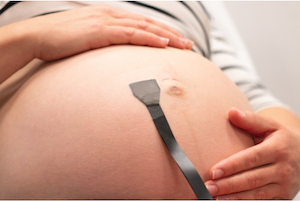
“With continuous monitoring, we were able to observe dynamic fluctuations in blood flow that would likely be missed with conventional ultrasound exams,” Huang said.
“Our system even detected an abnormality during one of our clinical visits,” Park added. “That pregnancy later resulted in a delivery at 29 weeks, and it demonstrated how continuous monitoring could help identify complications much earlier than we can today.”
This project builds on over a decade of research at UC San Diego in the laboratory of chemical and nano engineering professor Sheng Xu. His team has led development of wearable ultrasound technology for a range of healthcare applications, including non-invasive monitoring of central blood pressure as well as mobile heart monitoring and efforts to use everyday gestures to reliably control robotic devices. This research was conducted in the Aiiso Yufeng Li Family Department of Chemical and Nano Engineering at the UC San Diego Jacobs School of Engineering.
For this new work, the team evaluated the wearable ultrasound patch through a multi-center clinical study conducted at Jacobs Medical Center at UC San Diego Health and the John Radcliffe Hospital at the University of Oxford. In tests, the patch produced measurements that closely matched those from standard handheld ultrasound devices. Researchers also collected continuous monitoring data for hours at a time across 62 pregnancies, including healthy pregnancies as well as pregnancies complicated by gestational diabetes, pre-eclampsia, high blood pressure and abnormal fetal growth.
Next, the team plans to integrate the patch into a compact electronic system that could eventually allow the patch to operate wirelessly.
On November 1, 2025, Xu moved his primary academic affiliation to Stanford University, where he is a faculty member of the Department of Anesthesia, Perioperative and Pain Medicine, with courtesy appointments in Electrical Engineering and Materials Science and Engineering.
Full study: “Fetal monitoring for high-risk pregnancies using a wearable ultrasound patch.”
This work was supported by Wellcome Leap (HER01430), the National Institutes of Health (1R01EB033464-01 and 1R01HL171652-01) and Accelerating Innovation to Market at UC San Diego.
Disclosures: Sheng Xu is a cofounder of Softsonics LLC. Maria Tome, Lawrence Impley and Antoniya Georgieva, all at University of Oxford, are cofounders of Safer Birth LTD. Aris T. Papageorghiou (University of Oxford) is a Senior Scientific Advisor of Intelligent Ultrasound Ltd. All other authors declare no competing interests.

 October 05, 2026