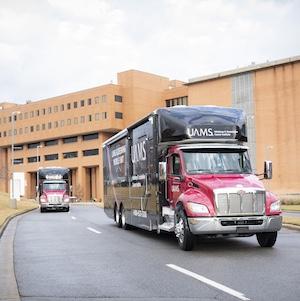
The Winthrop P. Rockefeller Cancer Institute has deployed
two of three new state-of-the-art mobile lung screening coaches,
with the third to follow shortly.
All photos: Evan Lewis, University of Arkansas for Medical Sciences.
Oct. 23, 2026 — The University of Arkansas for Medical Sciences (UAMS) Winthrop P. Rockefeller Cancer Institute recently announced the arrival of Arkansas’ first lung cancer screening vans and the launch of a statewide effort to reduce the state’s leading cause of cancer death.
Lung cancer causes approximately 2,000 deaths each year in Arkansas, which far exceeds the national average. The state ranks fifth in the nation for lung cancer mortality and third for cigarette smoking. Smoking causes nearly 90% of all lung cancers, according to the Arkansas Department of Health, with the heaviest burden falling on rural and medically underserved communities.
“Arkansas has some of the highest lung cancer rates in the country with far too many families losing loved ones to a disease that is survivable when detected early,” said Michael Birrer, M.D., Ph.D., vice chancellor of UAMS and director of the Winthrop P. Rockefeller Cancer Institute. “These mobile screening units will fundamentally change access to cancer care by taking lifesaving screening directly to the communities that need it most.”
Thanks to a $4 million appropriation administered by the U.S. Department of Health and Human Services Health Resources and Services Administration and championed by U.S. Sen. John Boozman, the Winthrop P. Rockefeller Cancer Institute has deployed two of three new state-of-the-art mobile lung screening coaches, with the third to follow shortly.
“It was an honor to secure this funding for resources that will expand access to lifesaving lung cancer screening across our state. UAMS is a great partner in bringing quality care to more Arkansans, especially those in more rural communities, and this mobile cancer screening capability will result in increased early detection and better outcomes,” said Boozman.
“By bringing these units to where people live and work, we are removing some of the biggest barriers to screening — transportation, time, and cost,” said UAMS Chancellor C. Lowry Barnes, M.D. “This effort reflects our commitment to rural health.”
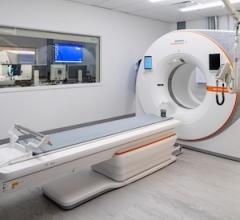
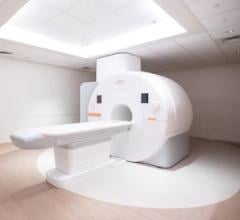
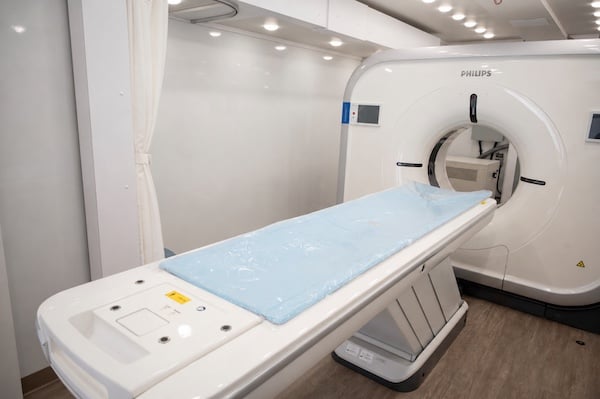
Each coach is equipped with a Philips Incisive CT 5100 scanner, providing high-quality imaging at low-radiation doses. The units operate with advanced battery and solar-power systems and are designed for safe, efficient mobile use in rural communities.
Expanding Access to Lung Screening
“Expanding access to care is a shared priority for UAMS and Philips, especially for people in rural communities who may live far from a hospital or imaging center,” said Brian Murphy, vice president, head of imaging, North America, Philips. “By equipping these mobile units with Philips CT systems, the program will help make CT screening services available in more rural communities across Arkansas. We are pleased to support UAMS in expanding access to these services.”
Patients screened through the program will also receive tobacco cessation counseling and resources, which recent studies show can increase quit-success rates by 40% when continued for at least three months. Low-dose CT screening itself has been shown to reduce lung cancer mortality by 20%.
Eligibility determination, insurance verification, and follow-up care are coordinated by Cancer Institute employees to ensure patients receive timely diagnostic support when needed. Under Act 390, an Arkansas law that went into effect Jan. 1, Medicaid and commercial insurance plans are required to cover lung cancer screenings for eligible individuals.
Screening is recommended for: adults ages 50 to 80 years, current smokers or former smokers who have quit within the past 15 years, adults with a smoking history of at least 20 pack-years (one pack a day for 20 years, two packs a day for 10 years, etc.), and adults with a family history of lung cancer, exposure to radon or asbestos, and Chronic Obstructive Pulmonary Disease (COPD).
Statewide maps of lung cancer incidence and mortality will guide the deployment of the vans so that the highest-need areas of the state receive priority outreach. The Cancer Institute will measure statewide impact by tracking screening participation rates, early-stage detection rates and reductions in late-state diagnoses.
Jeff Pasquale, CEO of USA Mobile Medical said, “We are proud to partner with UAMS on this groundbreaking initiative to support their mission of meeting patients where they are and ensuring access to lifesaving lung cancer screening directly to the communities throughout the state of Arkansas that need it the most.”
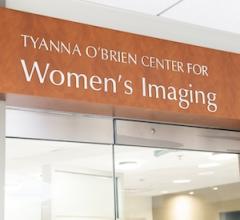
For more than 16 years, the UAMS MammoVan has provided breast cancer screenings across the state. To further expand access to care, UAMS has launched a second MammoVan with plans to deploy a third, creating more opportunities for patients to access life-saving cancer screenings closer to home.
When fully implemented, the Cancer Institute’s mobile cancer screening fleet will include six vans, making it the largest in the United States.
 October 19, 2026