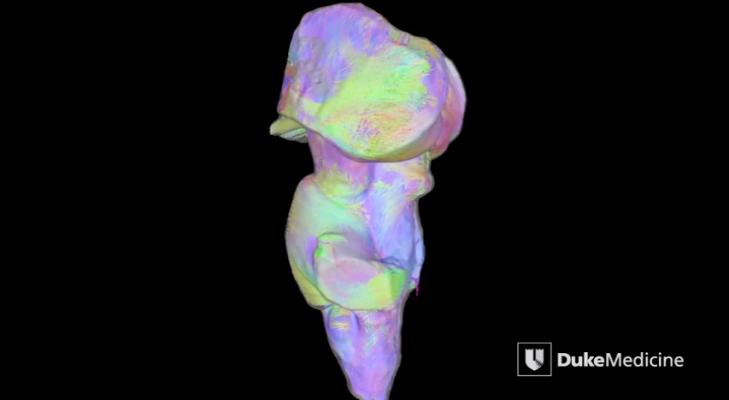
Image courtesy of Duke Medicine
June 11, 2015 - Scientists at Duke Medicine have produced a 3-D map of the human brain stem at an unprecedented level of detail using magnetic resonance imaging (MRI) technology.
In a study published June 3 in Human Brain Mapping, the researchers unveiled an ultra high-resolution brain stem model that could better guide brain surgeons treating conditions such as tremors and Parkinson's disease with deep brain stimulation (DBS).
The new 3-D model could eliminate risky trial-and-error as surgeons implant electrodes - a change akin to trading an outdated paper road atlas for a real-time GPS.
"On the conventional MRI that we take before surgery, the thalamus looks like a gray mass where you can see only the borders," said neurosurgeon Nandan Lad, M.D., Ph.D., director of the Duke NeuroOutcomes Center and an author of the paper. "Now we will have actual detail. With this map, for the first time we're able to see the thalamus and that underlying circuitry that we are modulating."
Many neurosurgeons currently rely on lower resolution computed tomography (CT) and MRI scans and geographic coordinates relative to the planes of the brain to guide them when placing electrodes into the thalamus. They are targeting a circuit called the dentatorubrothalamic tract or DRT (depicted as an X-shaped pathway in the accompanying image), Lad said.
Surgeons must often remove and reinsert electrodes and test frequencies to find the spots inside the thalamus where, for instance, the electric current subdues the hands of a patient with debilitating tremors. This indirect targeting is the standard of care for DBS, but comes with risk. Moving an electrode requires another pass through delicate tissue, and complications from DBS can include hemorrhage, seizure or memory problems.
"This map will potentially help us reach the optimal target the first time," Lad said. "It could eliminate trial and error and make the surgery safer."
The map was produced from a 10-day scan of a healthy donor's postmortem brain stem in a 7-Tesla MRI system, and then converted into a 3-D model that can be proportionally scaled to fit a person's unique brain anatomy using a high-performance computing cluster.
"These images are 1,000 times more detailed than a clinical MRI," said G. Allan Johnson, senior author of the paper and director of the Duke Center for In Vivo Microscopy where the brain stem was scanned. "You can actually see the nerve fibers in the brain, how they're crossing, and the subtleties of contrast between gray and white matter in the brain far beyond what a clinical scan could offer."
To test the accuracy of the model, the researchers conducted a retrospective study of 12 patients who had already been treated successfully for tremors using DBS. The researchers used the 3-D model to predict the best placement for the electrodes in each patient. The predictive computer model and the actual successful electrode placements correlated for 22 of 24 electrodes in the dozen patients, the study showed.
The researchers will soon begin a prospective study using the 3-D model to guide DBS surgery.
"As time goes on, imaging will only continue to get better," Lad said. "We are well-equipped and at the cutting edge of understanding how to apply this technology, and will be in an even better position to treat more patients with fewer side effects."
The Duke team will also pursue high resolution imaging of other circuits in the brain, brain stem and spinal cord to develop new treatments for other conditions.
"We now have a guide to be able to visualize these complex neuronal connections that would otherwise be impossible to see," said Evan Calabrese, Ph.D., the lead author of the paper who engineered the 3-D model. "This will help us continue to explore applications for treatments of Alzheimer's disease, neuropathic pain, depression and even obsessive compulsive disorders."
For more information: www.dukemedicine.org

 October 07, 2026