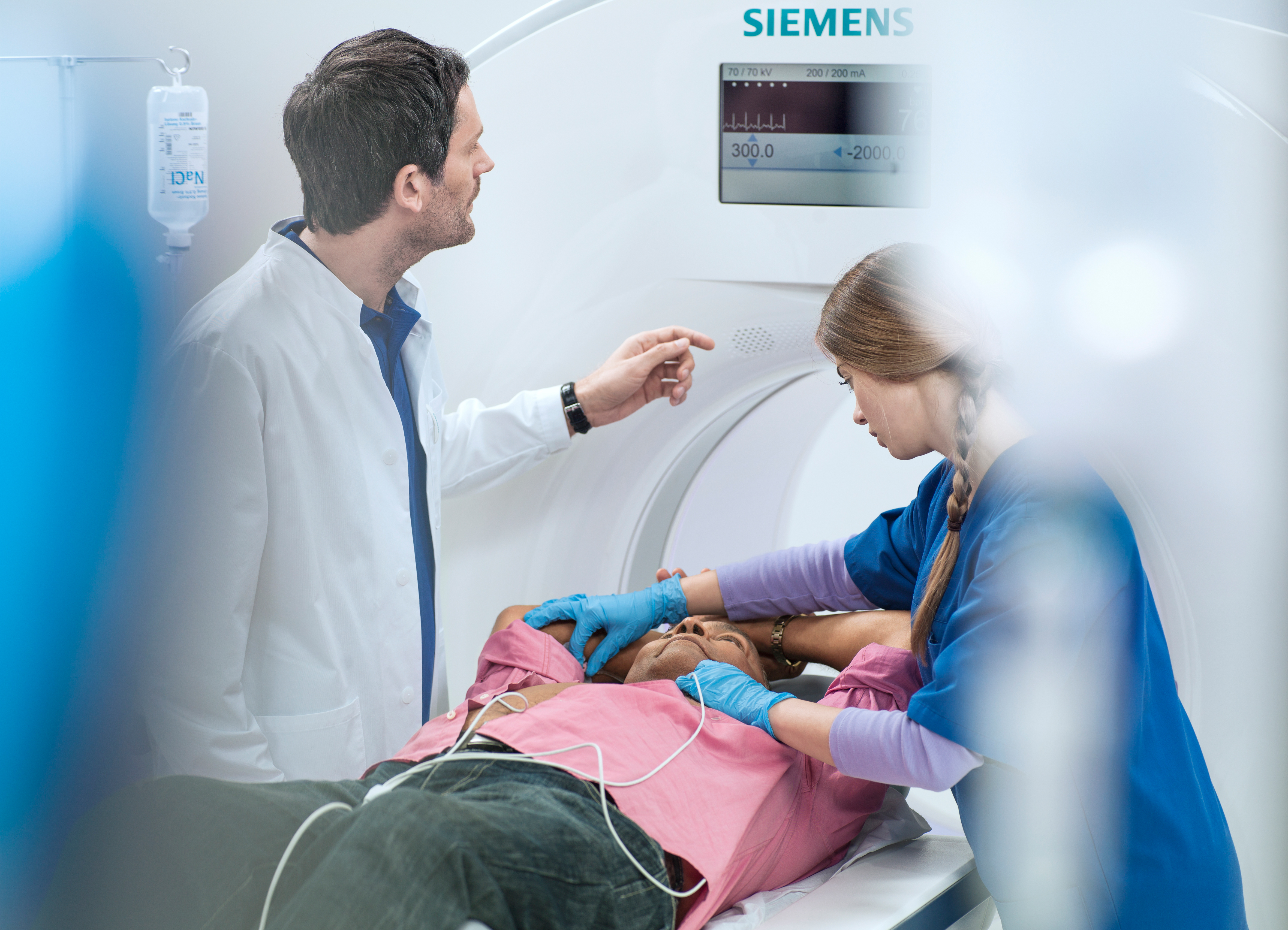
March 25, 2014 – UC Davis clinicians and physicists have recommended new strategies to make computed tomography (CT) safer, including adoption of a new metric for dose measurement, ways to manage exposure protocols that differ by CT brand and specific approaches to reduce exposure during needle biopsies. The recommendations are detailed in papers published in the March issue of the Journal of the American College of Radiology (JACR).
In response to concerns about the radiation dose in CT, JACR devoted the entire issue to CT safety. The federal government estimates that more than 80 million CT scans are performed in the United States each year. UC Davis specialists contributed three studies to the special issue.
CT is a powerful diagnostic technology that images organs and other internal structures. These scans can both detect life-threatening conditions and rule them out, giving clinicians precise information to develop a care plan. But there are risks. Ionizing radiation can damage cells and has been found to be a weak carcinogen. The challenge for radiologists and medical physicists is to find the optimal dosage for each CT exam.
“The higher the dose, the better the images,” said John Boone, vice chair of research in the department of radiology. “But you also want the lowest possible doses. So you need to find that balance between acceptable image quality and acceptable dosage.”
In the paper “Dose is Not Always What it Seems” Anthony Seibert, professor of radiology, and his colleagues discuss the need to improve dose calculations. They point to an actual case in which a pediatric patient who had scans before and after surgery appeared to receive an overdose on the second CT. Further investigation showed that the problem was a misleading metric — the volume CT dose index (CTDIvol), a standard measure of radiation output in CT. Manufacturers use phantoms along with instruments that measure radiation to assess CTDIvol. However, different companies use phantoms of different sizes. In addition, many dose estimates are based on adult sizes, making pediatric estimates more difficult.
“In this case, the difference was the way the manufacturers handled the metrics,” said Seibert. “A large phantom tends to underestimate dose, while a small phantom tends to overestimate it. When we compensated for the different-sized phantoms, it turned out the patient received almost the same dose in both scans.”
To help prevent future problems, the team recommended a new metric, size-specific dose estimate (SSDE), which provides a better way to measure patient dose and can also help compare scanners from different companies. It also addresses the dire need to more accurately estimate doses from CT across a range of patient sizes, from newborn to NFL linebacker.
“I think SSDE is one step closer to a dose metric that will be more accurate in depicting the actual risk to patients,” said Seibert.
This is not the only area where differences between scanners can obscure dosage. In another paper, “Methods for CT Automatic Exposure,” Boone, Seibert and colleagues addressed the challenges of optimizing different machines.
Physicists and radiologists must set up automatic exposure protocols, which vary doses based on tissue thickness. However, since manufacturers use different methods to control doses, transferring these settings between machines can be difficult and time-consuming.
“It takes a lot of effort to optimize any given scanner,” said Boone. “Going through the procedures for every possible exam could take two years.”
To ease the way, the UC Davis team developed equations to translate settings among three machines, two made by GE and one by Siemens. The proposed approach provides a more efficient way to manage CT protocols between different CT scanners.
A third paper, “Radiation Dose Optimization for CT-Guided Interventional Procedures” outlines how practitioners can lower radiation doses while performing interventional procedures under CT guidance. CT is often used to guide these procedures, ensuring the needle is precisely located.
Ramit Lamba, director of CT, outlines a number of methods to reduce radiation doses for both patients and doctors performing the procedures. He recommends using ultrasound, instead of CT, to guide some biopsies. He also recommends reducing scan lengths, lowering the tube current using dose-efficient scanning modes and limiting the number of guidance scans.
The special JACR issue is one piece of an ongoing effort to reduce CT risks. As part of the University of California Dose Optimization and Standardization Endeavor (UCDOSE), all five UC medical centers are collaborating to improve CT protocols and education.
“We’re trying to educate radiologists and medical physicists because the practice of CT is not consistent,” said Boone. “If someone is using higher doses to get results they could obtain with less radiation, we need to help them find the safer alternative.”
Other researchers included Rebecca Smith-Bindman of UC San Francisco; Sarah E. McKenney, formerly of UC Davis; and Sandra L. Wootton-Gorges of UC Davis. UCDOSE is funded through a pilot grant from the University of California Office of the President.
For more information: http://cancer.ucdavis.edu

 October 07, 2026