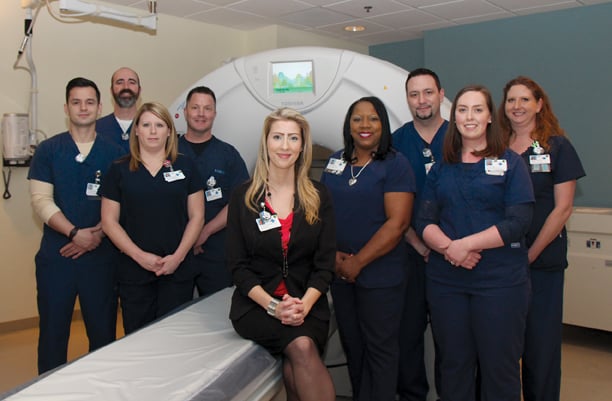
The Houston Healthcare CT imaging team.
Situation: Houston Healthcare was determined to be a leader in patient safety. It was using four Aquilion CT systems from Toshiba America Medical Systems, Inc. and needed to ensure they were maximizing the technology to image patients with the lowest possible radiation dose.
Solution: Houston Healthcare partnered with Toshiba to implement the comprehensive dose management program, PROTECT. Part of the PROTECT program included upgrading its three existing CT systems with the VeloCT console, which includes new enhancements for patient safety, dose management and workflow. Houston Healthcare also installed a brand-new Aquilion Prime to round out its CT offerings. To maximize this technology, Toshiba ensured the team was fully educated on the CT systems, new protocols and ways to answer questions from patients about the exams.
For Houston Healthcare in Warner Robins, Ga., patient safety has always been a priority. Clinicians can now image patients with the lowest possible dose without compromising diagnostic accuracy, and the facility has seen a 65 percent radiation dose reduction in routine abdomen/pelvis exams, a 59 percent dose reduction for routine chest exams and a 7 percent reduction in routine head procedures.
Benefits
ALARA Imaging: Toshiba’s PROTECT program helps support customers in achieving the lowest possible dose without compromising diagnostic image quality.
Lowering Dose and Meeting MITA XR-29 Smart Dose Standard: Through the VeloCT upgrade, existing systems can add the latest in dose reduction and workflow technologies, like AIDR 3D. AIDR 3D also enables facilities to meet MITA XR-29 Smart Dose standard and qualify for quality incentives to promote patient safety and public health in CT diagnostic imaging.
Making CT Safer for All Patients: Through educational initiatives and protocol review, PROTECT ensures customers have all of the tools and knowledge necessary to get the right dose for every patient, every time.
Radiation from medical imaging is in the public spotlight more than ever. Once a topic kept within the medical community, radiation dose is now top of mind for both patients and practitioners alike.
Houston Healthcare serves 300,000 people each year in the central Georgia region, and has worked to improve the healthcare communities served since its establishment in 1960. But as healthcare reform got underway, patient care and satisfaction became more important than ever.
For its CT imaging, Houston Healthcare was using three Aquilion systems and had just recently purchased a new Aquilion Prime from Toshiba. With the right CT technology, and a dose reduction committee with Toshiba’s strategic partner Phoenix Technology Corp., Houston Healthcare had its foundation in place and needed a program to tie all the elements together. That answer was Toshiba’s comprehensive dose management program, PROTECT.
A Role Model for Lowering Dose
PROTECT is a three-year, comprehensive CT radiation dose management program combining Toshiba’s technology solutions with its education and support. Through in-person collaboration, Toshiba experts review the system’s hardware and software, and consider implementation of additional dose reduction technologies. Now, Houston Healthcare can ensure quality care and safety are priorities during every patient exam.
As part of the program, Houston Healthcare upgraded its three existing Aquilion 64 CT systems with the most comprehensive dose reduction technologies and dose management tools, included as part of the VeloCT console upgrade.
“Technology upgrades through Toshiba’s VeloCT program, such as AIDR 3D, have been imperative to achieving dose levels significantly lower than the standards set by the American College of Radiology,” said Tim Sisco, director of cardiovascular and imaging services, Houston Healthcare.
Through the PROTECT partnership program, Houston Healthcare has achieved tremendous dose savings. Clinicians achieved a 65 percent reduction in routine abdomen/pelvis exams, a 59 percent dose reduction for routine chest exams and a 7 percent reduction in routine head procedures.
“Houston Healthcare has addressed the national concerns regarding radiation safety with a positive and proactive investment of resources toward improving patient safety in radiology,” said Sandra Paige, MS, medical physicist, Phoenix Technology Corp. “These efforts include providing education and training to the public and medical community to increase awareness about medical radiation exposure, and the implementation of new medical imaging equipment.”
PROTECTing Patients With Safer Exams
Not only does PROTECT help facilities lower dose, it also raises awareness and educates patients on CT technology and the importance of low dose exams.
“With the PROTECT program in place, both our physicians and technicians have learned how to have conversations with patients about dose safety and reassure them that the exams they are receiving are being conducted with the lowest possible dose to produce the high image quality required for accurate diagnoses,” Sisco said.
Lowering CT radiation dose is more than just good technology. Toshiba’s PROTECT program is a partnership that lets healthcare providers know that CT dose and safety is not a choice.
Case study supplied by Toshiba America Medical Systems.


 October 07, 2026