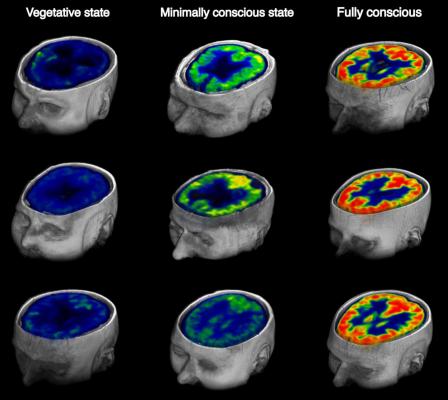
June 1, 2016 — Researchers have new evidence that readily obtainable measures of the amount of glucose (sugar) consumed by the brain can directly predict a person's current level of awareness, or the likelihood that they will recover awareness within a year of a severe brain injury. The study was reported in the Cell Press journal Current Biology on May 26.
The precise diagnosis and prognosis of recovery of consciousness of patients after a severe brain injury is a challenging clinical task, as some brain-injured patients retain certain levels of awareness despite appearing fully unresponsive.
"In nearly all cases, whole-brain energy turnover directly predicted either the current level of awareness or its subsequent recovery," said Ron Kupers of the University of Copenhagen and Yale University. "In short, our findings indicate that there is a minimal energetic requirement for sustained consciousness to arise after brain injury."
In the new study, Kupers, together with Johan Stender and colleagues from the University of Copenhagen in Denmark and the University of Liège in Belgium, aimed to develop more reliable diagnostic markers for the assessment of current and future levels of consciousness to complement routine bedside clinical examinations. To this end, they quantified and mapped cerebral glucose metabolism in 131 brain-injured patients, all of whom were suffering from either full or partial loss of consciousness.
The researchers measured glucose metabolism using FDG-PET (positron emission tomography), a well-known imaging technique in which glucose labeled with a radioactive tracer molecule is injected into the bloodstream. The labeled glucose makes it possible to capture and map glucose uptake in any organ of interest — in this case, the brain.
Their results showed that the patients' individual levels of behavioral responsiveness were strongly linked to their overall cerebral energy turnover. In fact, patients with glucose metabolism below a well-defined threshold of 42 percent of normal cortical activity appeared to be fully unconscious and did not recover consciousness at one-year follow-up. In contrast, nearly all patients with brain metabolic activity above this energetic threshold either showed signs of awareness at the initial examination or had recovered responsiveness a year later.
Overall, the cerebral metabolic rate accounted for the current level, or imminent return, of awareness in 94 percent of patients.
"The discovery of a clear metabolic boundary between the conscious and unconscious states could imply that the brain undergoes a fundamental state change at a certain level of energy turnover, in a sense that consciousness 'ignites' as brain activity reaches a certain threshold," Stender said. "We were not able to test this hypothesis directly, but it provides a very interesting direction for future research."
"The take-home message [for now] is that consciousness is a highly energy-demanding process, involving the brain at large," Kupers said. "This fundamental physiological trait can help clinicians determine the potential for recovery of awareness in patients suffering from severe brain injuries of any kind."
The researchers said it will be important to verify the findings in an independent patient population. They also hope to explore how brain metabolism changes over time in brain-injured patients.
The study was supported financially by the University of Copenhagen, the Belgian Fund for Scientific Research, the James S. McDonnell Foundation, the Belgian American Educational Foundation, the Wallonie-Bruxelles International, the European Commission, the European Space Agency, the Wallonia- Brussels Federation Concerted Research Action, and the Belgian interuniversity attraction pole.
For more information: www.cell.com/current-biology
 October 06, 2026