News | Ultrasound Imaging | May 25, 2022

Lung ultrasound performed by primary care physicians for clinically suspected community-acquired pneumonia: A multicenter prospective study

Researchers in Spain conducted a study to compare the diagnostic accuracy of lung ultrasounds (LUS) performed in the primary care setting to chest X-rays (CXR) performed by a radiologist when diagnosing community-acquired pneumonia (CAP).

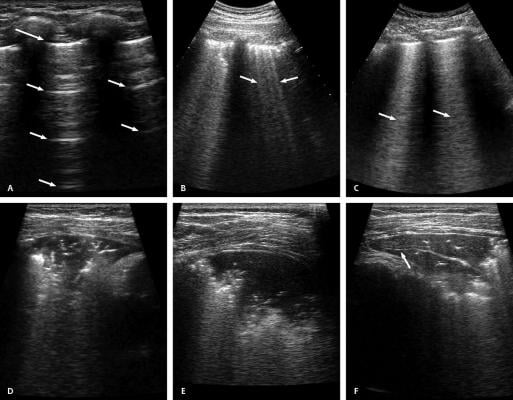
Representative images of various lung ultrasound patterns considered in this study. Image courtesy of Annals of Family Medicine.

Panel A: Normal lung ultrasound showing the A-lines pattern, with a well-defined pleural line (long arrow) and parallel A-lines (short arrows). Panels B and C: Pathological B-lines patterns showing multiple and separated B-lines (arrows in panel B) and coalescent B-lines (arrows in panel C). Panels D, E, and F: Images of consolidations, evident as subpleural hypoechogenic areas with an echogenic air bronchogram. Panel F also shows a hypoechogenic fluid bronchogram (arrow).


May 25, 2022 — Researchers in Spain conducted a study to compare the diagnostic accuracy of lung ultrasounds (LUS) performed in the primary care setting to chest X-rays (CXR) performed by a radiologist when diagnosing community-acquired pneumonia (CAP). While previous research demonstrates that ultrasounds are a useful tool to diagnose pneumonia in the hospital setting, most studies have not addressed diagnosis in the primary care setting where patients often present with less severe symptoms.

Over a seven month period, physicians at 12 primary care clinics performed LUS, followed by CXR, on 82 patients with clinically suspected CAP.  Researchers then compared each LUS finding with the corresponding CXR report. Their findings suggest that, for pneumonia cases detected by LUS, the test’s high specificity could mean it is safe for primary care physicians to directly prescribe antibiotics, thus reducing patients’ exposure to X-ray radiation and saving time and money.

All study participants had performed ultrasound in other areas of medicine, including abdominal ultrasound, and were able to achieve a high level of diagnostic accuracy after receiving only five hours of LUS training. Because the test can typically be performed in 10 minutes or less, the authors posit that incorporating LUS into daily practice may be a time- and cost-saving measure for patients and physicians alike.

For more information: www.aafp.org


Related Content

News | HIMSS

March 5, 2026 — At the Health Information and Management Systems Society (HIMSS) Conference & Exhibition 2026 in Las ...

Time March 06, 2026
arrow
News | Radiation Oncology

March 4, 2026 — Lunit has announced that 21 studies featuring its AI solutions will be presented at the European ...

Time March 05, 2026
arrow
News | Artificial Intelligence

March 2, 2026 — RadNet, Inc. has acquired Gleamer SAS, a radiology AI company based in Paris, France. Gleamer will be ...

Time March 03, 2026
arrow
News | Ultrasound Women's Health

March 2, 2026 — Ultrasound AI, a provider of artificial intelligence applications for medical imaging, has received FDA ...

Time March 03, 2026
arrow
News | FDA

Feb. 26, 2026 — AS Software, a provider of specialty-focused ultrasound reporting solutions, has announced that the U.S ...

Time March 02, 2026
arrow
News | FDA

Feb. 26, 2026 — The U.S. Food and Drug Administration (FDA) has given 510(k) class II clearance of qXR-Detect, the ...

Time February 26, 2026
arrow
News | Ultrasound Women's Health

Feb. 5, 2026 — BrightHeart, a global provider of AI-driven prenatal ultrasound, has announced the availability of its B ...

Time February 05, 2026
arrow
News | Radiology Education

Jan. 22, 2026—The American Roentgen Ray Society (ARRS) will host a live virtual symposium, "Medical Imaging for ...

Time January 28, 2026
arrow
News | Point-of-Care Ultrasound (POCUS)

Jan. 27, 2026 — Siemens Healthineers and World Athletics have joined forces to inform medical teams how point-of-care ...

Time January 27, 2026
arrow
News | Radiology Imaging

Jan. 26, 2026 — Researchers at the University of Arizona were awarded up to $1.8 million by the Advanced Research ...

Time January 26, 2026
arrow
Subscribe Now