
RELATED CONTENT
Feature
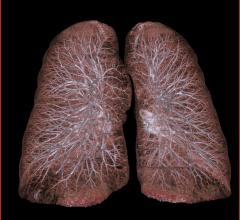
Americans at increased odds of a potentially lethal lung cancer diagnosis may soon be able to seek out the most promising technology available to detect it early and ultimately have screening covered by insurance, including Medicare. The U.S. Preventive Services Task Force (USPSTF) recommended a high "B" rating for annual computed tomography (CT) scans for current and former smokers, aged 55 to 80, with a history of heavy smoking (two packs per day over 20 years or one pack a day over 30 years).
 July 30, 2013
News
June 26 marked the 90th anniversary of the founding of the American College of Radiology (ACR) and a celebration of nine decades of work by ACR members, leadership and staff to make medicine better by advancing the science of radiology, educating radiology professionals, positively influencing health care policy and improving quality of care.
July 01, 2013 
Feature
The American College of Radiology (ACR) strongly urges Americans ages 50-and-older, particularly those with a family history of colorectal cancer, not to delay or forego recommended screening due to concerns raised by a June 1, New York Times article titled, “The $2.7 Trillion Medical Bill: Colonoscopies Explain why U.S. Leads the Work in Health Expenditures.”
June 10, 2013 
News
The American College of Radiology (ACR) has affirmed its support for the Diagnostic Imaging Services Access Protection Act (S. 623) recently introduced in the Senate by Senators Ben Cardin (D-MD) and David Vitter (R-LA).
March 27, 2013 News
The American College of Radiology supports the Diagnostic Imaging Services Access Protection Act (H.R. 846), recently introduced by Reps. Pete Olson (R-TX), Peter Roskam (R-IL), John Barrow (D-GA), Betty McCollum (D-MN) and 38 House cosponsors. H.R. 846 would correct a 25 percent multiple procedure payment reduction to Medicare reimbursement for interpretation of advanced diagnostic imaging scans performed on the same patient, in the same session.
March 01, 2013 Feature
New and updated evidence-based guidelines to help healthcare providers choose the most appropriate medical imaging exam or radiation therapy for a patient’s clinical condition are now available via the latest version of the American College of Radiology appropriateness criteria. These continually updated criteria are a national standard developed by expert panels of physicians from many different medical specialties.
February 26, 2013 Feature
Since its launch, less than two years ago, more than 5 million computed tomography (CT) scans, and nearly 3 million exams, have been added to the American College of Radiology (ACR) Dose Index Registry (DIR) — bringing the ACR closer to establishing national benchmarks for CT dose indices, which will help ensure patients receive safe, quality imaging care.
February 22, 2013 News
According to an article in the January issue of the ACR Bulletin, the ACR recently donated a one-of-kind film of Marie Curie receiving the ACR Gold Medal in 1931 to the Curie Museum in Paris. Famous for the discovery of polonium and radium, Curie was recognized by the ACR for her significant contributions to the field of radiology.
January 21, 2013 
News
Availability of CT colonography (CTC), commonly known as virtual colonoscopy, is increasing colorectal cancer (CRC) screening rates across military medical facilities. Inclusion of CTC as a Healthcare Effectiveness Data and Information Set (HEDIS)-compliant colorectal cancer (CRC) screening test can potentially raise overall screening rates, according to a study in the January issue of the Journal of the American College of Radiology.
January 11, 2013 News
A new Harvey L. Neiman Health Policy Institute study shows that fewer than one-in-five healthcare providers meet Medicare Physician Quality Reporting System (PQRS) requirements. Those that meet PQRS thresholds now receive a .5 percent Medicare bonus payment. In 2015, bonuses will be replaced by penalties for providers who do not meet PQRS requirements. As it stands, more than 80 percent of providers nationwide would face these penalties.
January 08, 2013 © Copyright Wainscot Media. All Rights Reserved.

Subscribe Now