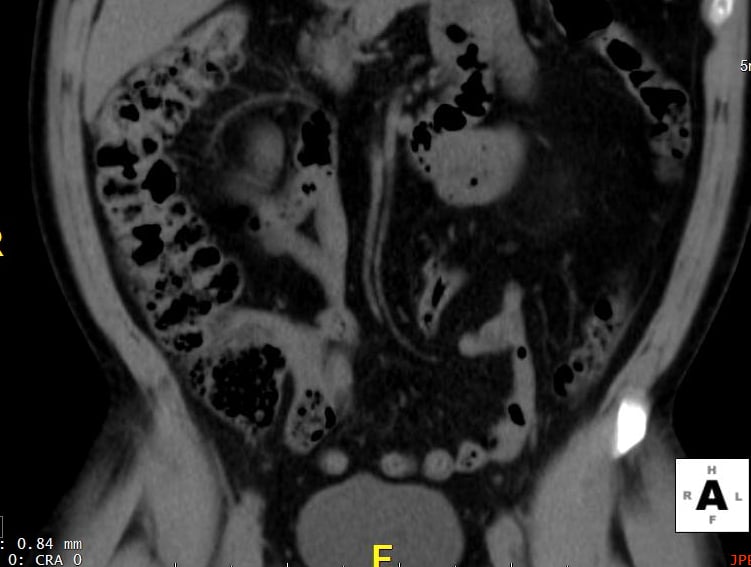
April 8, 2013 — In 2009, the Centers for Medicare and Medicaid Services (CMS) halted reimbursement for so-called “virtual colonoscopy” for routine colon-cancer screening in asymptomatic patients, in part due to concerns over how this procedure, computed tomography colonography (CTC), was being used in the elderly population.
In the first study to examine appropriate utilization of the test among asymptomatic Medicare beneficiaries from 2007 to 2008, a research team from the Perelman School of Medicine at the University of Pennsylvania found that CTC was used appropriately and may have expanded colorectal cancer screening beyond the population screened with standard (“optical”) colonoscopy. The findings, led by Hanna M. Zafar, M.D., MHS, an assistant professor of Radiology, are published online in the Journal of General Internal Medicine.
CTC is a minimally invasive method of visualizing the colon and rectum, which does not require sedation, unlike during standard colonoscopies. On average, CTC costs $400 to $800, and optical colonoscopy costs $1,500 to $3,000. However, patients with focal abnormalities on CTC (defined as suspected polyps greater than or equal to 6 millimeter and masses) must be referred for direct tissue sampling.
The Penn Medicine research team examined records for 10,538 asymptomatic older patients who underwent CTC compared to 160,113 similar patients who underwent optical colonoscopy. They found that the vast majority of patients who received CTC had presumed incomplete optical colonoscopies and thus were considered appropriate candidates for the virtual screening method. Furthermore, almost half of the patients studied who underwent CTC following incomplete optical colonoscopy did so on the same day as optical colonoscopy.
“Given that bowel preparation is a strong barrier to screening, offering same-day CTC could improve completion of screening by eliminating the need for an additional bowel preparation,” said Zafar. “As such, it is reassuring that CTC following incomplete optical colonoscopy is covered by most insurance companies and CMS.”
Additionally, 30 percent of the patients who underwent CTC had no history of incomplete OC but demonstrated other medically appropriate indications for screening CTC including risk of bleeding or sedation complications. Although the researchers were not able to assess through the claims data studied how many of these patients would not have been screened without the option of CTC, it does suggest that during the study period, this test may have expanded colorectal cancer screening as opposed to simply replacing optical colonoscopy. (Prior research has shown that nearly 30 percent of patients would not undergo optical colonoscopy if CTC were not available.) “Additional research is needed in this important area since approximately 40 to 50 percent of Medicare patients do not undergo any recommended method of colon cancer screening,” Zafar said.
The Penn Medicine study also found lower utilization of CTC among asymptomatic non-white patients. It is not clear whether this decreased utilization is due to overall lower rates of colorectal cancer screening in this group of patients, patient preference or diminished access to imaging technology. But previous findings indicate that minority populations are less likely to be aware of colorectal cancer screening procedures and more likely to believe that screening is only needed after symptoms develop — both represent barriers to colorectal cancer screening compliance. “Given the higher incidence and mortality from colorectal cancer among black patients and lower rates of screening in minority patients overall, this cohort could benefit most through CTC,” said Zafar.
For more information: www.sgim.org/jgim

 October 07, 2026