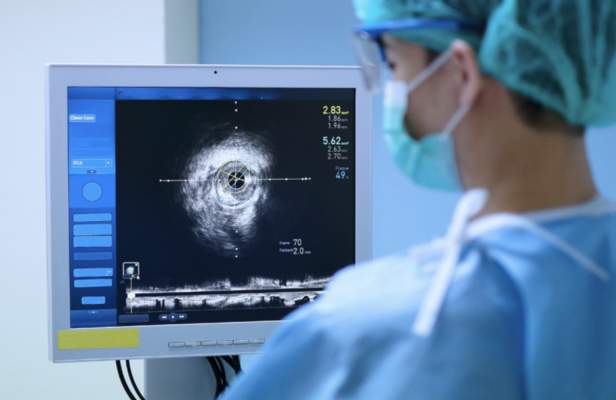
January 6, 2023 — Despite the significant advantages that ultrasonic technology provides, medical equipment makers are finding it challenging to continue to deliver improvements in image quality and accuracy. Today’s medical imaging tools are still limited in capability for real-time use due to challenges such as sequential data acquisition, limited portability, low frame rates (10 to 50 frames per second), and sub-optimal image focus, which can be attained only at a single depth.
To help improve the performance of imaging systems for healthcare providers and their patients, we’re introducing the first medical imaging libraries as part of the latest production release of our Vitis unified software development platform (Vitis 2022.2). These new accelerated libraries enable customers to get their medical imaging products to market faster by reducing development time. The Vitis libraries accelerate medical imaging on our Versal devices with AI Engines to allow real-time implementation of advanced imaging algorithms to significantly improve image quality, speed of loading images (including ultra-premium 3D/4D), and depth of optimal scan in premium medical imaging equipment.
These open-source libraries are targeted for applications with high digital signal processing (DSP) requirements, such as ultrasound beamforming, CT image reconstruction, MRI image reconstruction using 2D-FFT, gradient processor control for MRI magnets, image processing on sampled/digitized data from inputs on X-ray, ECGs, and more.
Real-time, Premium Imaging
We know that performance is critical when it comes to medical imaging. Better image quality can help doctors find and treat a tumor before it spreads or diagnose a patient’s cause of pain quickly and effectively.
Leveraging our unique AI Engine technology, a highly parallel mesh of hundreds of interconnected processor cores in Versal adaptive SoCs, customers can achieve high-quality imaging at a rate of upwards of 1,000 frames per second, which is many times faster than competing GPU-based devices[1].
As an example, customers can deploy a very high-performance parallel ultrasound beamforming algorithm in a single Versal chip and achieve optimal focus anywhere in the image with highly accurate results – even for difficult-to-scan abdominal or cardiac imaging.
Improved Time-to-Market
One of the biggest limitations hindering widespread adoption is that the hardware development needed to implement imaging algorithms is complex, time-consuming, and lacks flexibility.
We’re changing this dynamic by reducing coding complexity for developers in order to accelerate innovation. Using the out-of-the-box-ready Vitis unified software programming environment, customers can develop in familiar C or C++ languages, or convert Matlab algorithms directly using Simulink.
Users can leverage easy-to-use support resources, including the ability to choose from modular software libraries ranging from building blocks to the full reference design, to quickly take an idea from concept to product.
A Three-Leveled Library Structure
Using a range of available options from building blocks in Level 1 to a complete ultrasound beamformer design in Level 3, customers can get their medical imaging products to market faster. Our software libraries, documentation, and example design demonstrate how to build such a design using Versal devices with AI Engines.
Any medical imaging equipment maker can choose to rapidly deploy their algorithms using basic building blocks in Level 1 and a high-level programming language. For ultrasound equipment makers, Level 2 of the libraries can be used to deploy their algorithms using a high-level programming language to achieve rapid time-to-market. Our toolbox in library Level 2 contains all the functions and examples on how to build a custom high-performance ultrasound beamformer, and library Level 3 provides a ready-made application with a fully working beamformer.
With the new accelerated libraries in the Vitis 2022.2 unified software platform, AMD is making real-time, premium medical imaging technology more accessible and easier to develop - removing barriers to innovation and advanced healthcare for all.
For more information: https://www.xilinx.com/
Reference:
[1] Compared to the Nvidia RTX2070 gaming GPU.

 October 08, 2026