The study "Will We Solve Crimes with Radiomics? Results of an Experimental Study on Charred Human Bone Samples," was presented at the Virtual Radiological Society of North America's 2020 conference (RSNA20). Radiomics, which extracts data from clinical images, can be reliably used to assess changes in the bone structure due to fire exposure.

December 1, 2020 — The study "Will We Solve Crimes with Radiomics? Results of an Experimental Study on Charred Human Bone Samples," was presented at the Virtual Radiological Society of North America's 2020 conference (RSNA20). Radiomics, which extracts data from clinical images, can be reliably used to assess changes in the bone structure due to fire exposure. Specific features can be applied to determine the interval of combustion.

Combustion is often applied to conceal corpses after murders. Therefore, establishing the timing of the combustion can provide fundamental details in forensic investigations. This study assesses the role of radiomics in characterizing time-related changes occurring in human bone samples exposed to fire and proposes a method that can be applied to provide additional information useful in determining the time and cause of death.

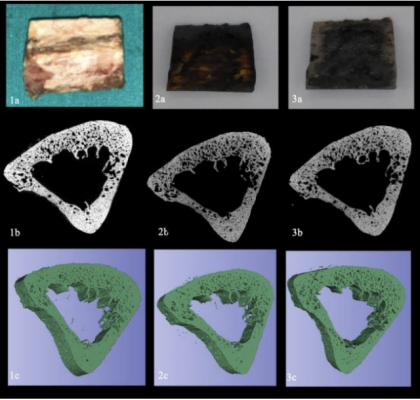
Fifteen samples of human fibulae were examined by a high-resolution micro-CT before and after direct exposure to fire for three combustion intervals. (Three samples were excluded after fragmentation during the second combustion.) From each sample, at each combustion interval, bone density and volume and 55 radiomic features were extracted. The results showed that radiomics was able to detect changes in the bone samples dependent on time of exposure to the fire.

The authors include Amalia Lupi, M.D., Presenter, Arianna Giorgetti, Guido Viel, M.D., Ph.D., Giovanni Cecchetto, M.D., Roberto Stramare, M.D., Chiara Giraudo, M.D., Ph.D.

For more information: www.rsna.org


Related Content

News | Innovative Hospitals

July 27, 2026 — Vanderbilt Health and Siemens Healthineers have entered into a multi-year, $87 million Value ...

Time July 28, 2026
arrow
News | Pediatric Imaging

July 17, 2026 — In June, UW Health Kids began welcoming patients into a new state-of-the-art imaging suite dedicated to ...

Time July 23, 2026
arrow
News | Information Technology

July 20, 2026 — GE HealthCare has introduced MIM Anyware, a remote access platform that provides secure, healthcare ...

Time July 20, 2026
arrow
News | ACR

July 15, 2026 — The American College of Radiology (ACR) recently issued a statement praising the inclusion of the ...

Time July 16, 2026
arrow
News | Cardiac Imaging

July 8, 2026 — Conavi Medical Corp. has announced the publication of a case report in the Journal of the Society for ...

Time July 15, 2026
arrow
News | PET Imaging

July 14, 2026 — New research is shedding new light on the biological basis of schizophrenia by directly measuring ...

Time July 15, 2026
arrow
News | X-Ray

July 14, 2026 — A team of crew members aboard a commercial spaceflight acquired the first diagnostic X-rays during an ...

Time July 14, 2026
arrow
News | Mammography

June 23, 2026 — Using artificial intelligence (AI), researchers found that image-based risk scores for breast cancer ...

Time June 24, 2026
arrow
News | Pediatric Imaging

June 16, 2026 — Crescom has officially launched a global clinical Proof of Concept (PoC) of its pediatric ...

Time June 24, 2026
arrow
Feature | X-Ray | Kyle Hardner

Water-window X-rays allow researchers to visualize biological cells at high contrast without staining agents or other ...

Time June 23, 2026
arrow
Subscribe Now