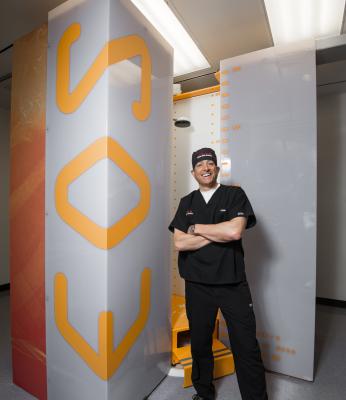
Texas Health Presbyterian Hospital Plano is the first hospital in North Texas to offer full-body three-dimensional imaging with a lower dose of radiation than traditional imaging.
The EOS Imaging System uses 50 to 85 percent less radiation than with digital radiology, and 95 percent less radiation than basic CT scans. This is a significant benefit over time for patients who have to be imaged regularly or have certain conditions that make lying down challenging, including children, the elderly and those with spinal deformities. Scoliosis patients, many of whom are teens, will typically undergo imaging every three to six months for a period of years while they receive treatment.
“When an adolescent has a spine abnormality, they undergo many imaging exams throughout their lifetime, so reducing their radiation dose over time is a benefit to their overall health,” said Isador Lieberman, M.D., M.B.A., FRCSC, orthopedic surgeon on the medical staff and medical director of the Scoliosis and Spine Tumor Center at Texas Health Plano.
In less than 20 seconds, the machine scans the patient’s front and side with two very fine X-ray beams, which are combined to generate a 3-D composite image if needed of the patient’s entire body, or a targeted image of a single anatomical area, like the leg or vertebral column.
“The system produces incredibly precise images of complex spinal conditions, helping us to determine the course of treatment.” Lieberman said. “The 3-D image, in comparison to 2-D, is much more involved, showing the true nature of a deformity or misalignment. As a surgeon, my goal is to provide the most appropriate and least invasive care to my patients, so being able to see this detail is a huge benefit. I am thrilled that our patients now have access to this technology.”
An additional advantage of the technology is that it scans the patient while standing or sitting, so the physician sees a functional image of the body, as opposed to a patient lying down. This can increase the physician’s understanding of how the spine, hip or knee is working. Standing or sitting is also more convenient for patients who have limited mobility or use wheelchairs. The image produced is not distorted or magnified in transmission, giving surgeons exact measurements, which are immediately available for physician interpretation, cutting down on processing and wait time for physicians and patients.
“We are very pleased to be bringing this technology to the people of North Texas,” said Josh Floren, FACHE, president of the hospital. “Reducing the radiation exposure for our patients is of utmost concern, as is helping our physicians better see inside the body, which may encourage less-invasive care. This is especially important to us as an organization that focuses on increasing the long-term health and well-being of our community.”
The imaging system will also benefit the hospital’s orthopedic program, as it has been shown to be appropriate for a range of musculoskeletal conditions, including those of the hips, knees and spine. The system was developed based on the work of Georges Charpak, who won the Nobel Prize for Physics in 1992.
For more information: www.TexasHealth.org/Plano

 October 07, 2026