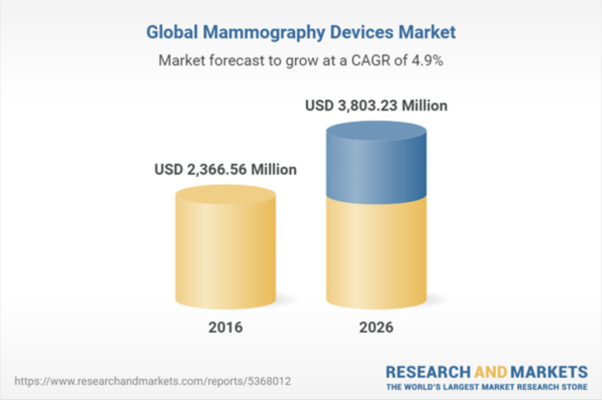
February 22, 2022 — The Global Mammography Devices Market stood at $2744.07 million in 2020 and is expected to grow at a steady CAGR of 5.78% during the forecast period. The growth of mammography devices can be attributed to the growing prevalence of breast cancer across the globe. Cancer is a terminal disease and under many cases early diagnosis is very difficult, making it more life threatening. Mammography devices helps to identify any kind of lesions in the mammary glands which is used for the identification of the cancer. This in turn is expected to drive the market growth. Additionally, supportive government policies and initiatives across the globe to create awareness among the female population regarding breast cancer its symptoms is expected to fuel the market growth through 2026. Also, various non-governmental organizations, hospitals and other and public welfare organizations keep on organizing camps and awareness campaigns to spread awareness pertaining to breast cancer. All these factors are expected to positively influence the market in the next five years.
However, the sudden outbreak and spread of the COVID-19 pandemic has significantly impacted the growth of the Global Mammography Devices Market. The surge in COVID-19 cases worldwide led to development of fear among the population, people stopped visiting hospitals for regular health-checkups and diagnostic procedures. Additionally, the hospitals also stopped the functioning of general hospital care for non-COVID-19 patients and completely focused on COVID-19 patients across the globe. Above-mentioned factors are expected to negatively impact or hinder the growth of the Global Mammography Devices Market.
The Global Mammography Devices Market is segmented on the basis of product type, technology, end-user, and regional distribution. Based on technology, the market can be categorized into digital and analog. Among these, digital technology segment dominated the market in 2020 with an overall share of 69.90%. Growth in the segment can be ascribed to the rapid technological advancements, leading to the adoption and utilization of digital technology in the mammography devices. Although the technique is quite expensive, but the high precision and specificity offered makes it a popular choice across the globe. Digital mammography is a specialized and advanced form of mammography that uses digital receptors and computers instead of X-ray films to examine breast tissue for the presence of tumors.
Based on regional distribution, the market can be split into Europe, North America, Asia Pacific, South America and Middle East & Africa. Among these regions, Asia Pacific is expected to register the highest growth during the forecast period on account of the growing prevalence of breast cancer in the region. Additionally, increasing awareness pertaining to breast cancer and breast health is further strengthening the market growth in the region. In the Asia Pacific region, Australia observes the highest prevalence of breast cancer. The rate of breast cancer prevalence in Australia is around 94.5 per 100,000 of population which contributes to the dominant share of the country in the region.
For more information: www.researchandmarkets.com
Related Breast Imaging Content:
COVID-19 Vaccine Can Cause False Positive Cancer Diagnosis
Help Spread Awareness of Potential COVID-19 Vaccine Imaging Side-effects
VIDEO: COVID Vaccine May Cause Enlarged Lymph Nodes on Mammograms — Interview with Constance "Connie" Lehman, M.D.
COVID-19 Vaccination Axillary Adenopathy Detected During Breast Imaging
VIDEO: COVID Vaccine Adenopathy Can Last Up to 10 Weeks — Interview with Yael Eshet, M.D.
VIDEO: Artificial Intelligence Trends in Medical Imaging — Interview with Signify Research
Technology Report: Artificial Intelligence in Radiology 2021

 October 19, 2026