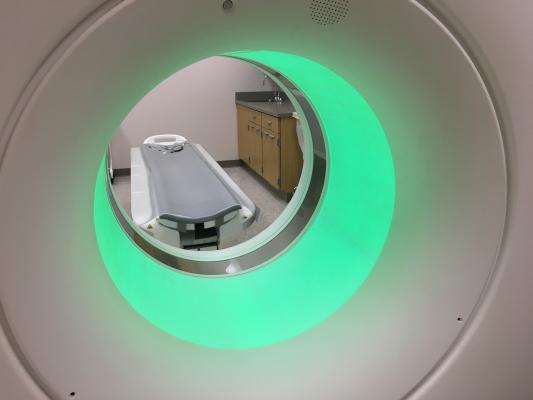
November 8, 2019 — The global computed tomography (CT) scanner device and equipment market was valued at about $6.9 billion in 2018 and is expected to grow to $8.04 billion at a CAGR of 3.9% through 2022.
The computed tomography scanners devices and equipment market consists of sales of computed tomography (CT) scanners devices and equipment and related services. CT scanners are used in the diagnosis of various diseases including cancer, bone related diseases, cardiovascular diseases, gynecological diseases, urological diseases, and other diseases.
CT scanners use computer-controlled X-rays to create images of the body. A CT scan is a three-dimensional method of scanning. The key product types include low end segment (single and dual slice CT scanners), mid end segment (multi slice scanners), and high end slice segment (open versions, and cardiac CT scanners).
In 2017, North America was the largest region in the CT scanners devices and equipment market, followed by Asia Pacific. During the forecast period, the computed tomography (CT) scanners devices and equipment market in Asia Pacific is forecasted to register the highest CAGR.
Rising prevalence of cancer and cardiovascular diseases are driving the computed tomography (CT) scanners devices and equipment market. According to the Centers for Disease Control and Prevention in the USA, the number of new cancer cases will go up by 24 percent in men and 21 percent in women by 2020, compared to 2010.
The rising need for early stage detection and prevention of these life-threatening diseases, increase the demand for proper diagnostics which poses as an opportunity for CT scan manufacturers. For instance, in 2016, according to a study conducted by American Heart Association, a non-profit organization in the USA, total medical costs for cardiovascular diseases are expected to reach $749 billion by 2035 from $351.2 billion in 2015.
Effects of radiation and increasing health concerns hinders the computed tomography (CT) scanner devices and equipment market growth. Diagnostic imaging procedures use CT scanner devices that release electromagnetic waves or particles called 'ionizing radiation'. This radiation coming from manmade sources such as CT scans, nuclear medicine scans and PET scans carry major health hazards and risks. Low doses can cause cancer in the long run. Cancer is a leading cause of death worldwide, accounting for an estimated 9.6 million deaths in 2018. When doses exceed certain levels it causes skin burns and acute radiation syndrome. According to a global survey in 2015 conducted by National Council on Radiation Protection and Measurements (NCRP), on radiation overexposure accidents, 2,390 people were over exposed to radiation, out of which 190 died.
Companies in the industry are integrating medical imaging with healthcare IT technology by providing digital access to improve patient safety, enhance healthcare facility and save patient time and money. The data from CT scans are being integrated with an image processing and communicating system such as picture archiving and communication system (PACS), that brings CT images from multiple systems into one interface. This enables radiologists to securely store, digitally transmit electronic images and clinically-relevant reports, and make use of a comprehensive database of images in order to give an accurate diagnosis.
These are increasingly incorporated and used for clinical analysis, diagnosis and treatment in departments such as radiology, nuclear medicine imaging, cardiology, pathology, oncology and dermatology. For example, Carestream health is a company that makes PACS (Picture archiving communication system) machines that integrates images from different sources under one interface. An agreement has signed by Philips to acquire Carestream health in March 2019.
In 2016, a regulation on Radiation Protection-Computed Tomography was made by Department OF Health (DOH), Washington, which was effective from July 2017. According to the regulation, CT scan device manufacturers are not allowed to make protocol changes or other software changes or any upgrades impacting the radiation dose or image quality. They need approval of the lead interpreting CT physician, technologist, or the medical physicist to allow appropriate changes.
If any uncertainty in the device that emit ionizing radiation which are supposed to comply with the given performance standards related to machine organization and other important metrics. There can be a product recall, medical alert or any safety notice sent to the manufacturer. Therefore, the manufacturers of medical imaging devices should reduce their ionizing radiation levels effectively in order to minimize the costs, and reduce timelines for approval. The stringent regulations like these might affect the computed tomography scanner devices and equipment market.
Major players in the market are GE Healthcare, Koninklijke Philips N.V., Hitachi Ltd., Siemens and Canon Medical Systems Corporation.
Other Companies Mentioned
- Neusoft Medical Systems
- Hitachi Healthcare America
- Neurologica
- Samsung Electronics
- Shimadzu Corporation
- Amber Diagnostics
- Shenzhen Anke High-Tech
- Fujifilm Holdings
- Koning
- Danaher Corp
- Medtronic
- ScanCO Medical AG
- United Imaging
- Carestream Health
- Planmed
- Sectra
- Atlantis Worldwide
- NCD Company
- Dunlee
- Shared Imaging
For more information: https://www.researchandmarkets.com/r/e3v9hh

 October 08, 2026