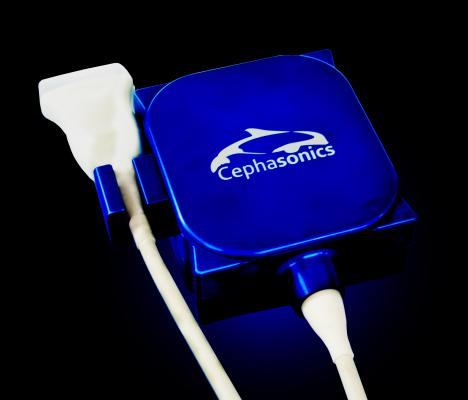
November 20, 2013 — Cephasonics introduced the small, 2-pound cQuest Dragonfly family of modular 32- or 64-channel, high-performance ultrasound systems, which, along with the included cQLink network communications technology, it will showcase at Medica 2013 Nov. 20-23 in Dusseldorf, Germany. Cephasonics will be located in the U.S. Pavilion in Hall 16, Booth D18-3. Following Medica, Cephasonics will be exhibiting Dragonfly at the Radiological Society of North America Annual Meeting (RSNA 2013) Dec. 1-6 in Chicago.
“The technology is a game-changer in two ways,” said Bern Shen, chief medical officer, HealthCrowd and member of the Cephasonics Medical Advisory Board. “One is the quality of the images and the other is the size and portability.”
“Only 5 inches [by] 4 1/2 inches [by] 2 inches in size and weighing just two pounds, Dragonfly is a full-fledged high-performance embedded-ultrasound system," said Richard Tobias, CEO and president, Cephasonics. "Our flexible API software makes it easy for our customers to go into production quickly with a range of ultrasound-based end products with industry-leading size, performance and cost.”
Two typical use cases are small point-of-care appliances for clinical applications and wearable wireless ultrasound devices for both medical and industrial applications.
Cephasonics’ new cQuest Dragonfly platform supports up to 192-element probes. The included cQuest Ultrasound API software gives customers an easy, fast way to develop ultrasound-based products from portable standalone imagers to application-specific appliances to adding ultrasound capability to existing equipment in medical and industrial applications. The system hardware transmits and receives analog, digital and power circuitry along with an embedded host MCU. The system design builds upon Cephasonics’ products, including its AutoFocus beamforming technology.
Announced earlier in 2013, cQLink client/server technology allows all control and ultrasound data between the server and client sides to take place across a wireless Wi-Fi network or over the Internet. Ultrasound applications developed with cQLink no longer need to run adjacent to the underlying cQuest Ultrasound hardware. Up to eight displays can be hooked up.
Key Specifications
Thirty-two-channel ultrasound blade (1 or 2 blades for 32- or 64-channel system):
- 40 Msps, 12-bit receive analog-front-end
- Three-level or five-level transmit pulsing
- AutoFocus receive beamformer with delay and weight values updated on every sample
- Transmit beamformer with programmable pulse shape tables
Probe interface:
- ZIF260 connector supporting 128- or 192-element probes
- Probes supported: phased array, linear, convex, custom; 1-D/2-D
Host:
- Ultrasound control with high-precision timing sequencer
- Nvidia Tegra 3 computer module (Toradex Colibri)
- Support B-mode log, harmonic imaging, M-mode and Doppler modes such as CFM, PDI and PWD in duplex or triplex
Software:
- cQuest Ultrasound API
- FrameViewer application example (executable and source)
- cQLink client/server technology
Power consumption: 20W (typical, 32-channel with embedded host)
Dimensions:
- Size: 5 inches by 4.5 inches by 2inches; 12.7 cm by 11.5 cm by 5.1cm
- Weight: 2 pounds; 0.9kg (32-inch product)
Pricing and availability
Projected pricing for Dragonfly in a 64-channel configuration is $5,000 based on a high-volume, production-quantity order. First shipments are scheduled to start in the first quarter of 2014. Other members of the Dragonfly family will be rolled out in the first half of 2014.
For more information: www.cephasonics.com, www.medica-tradefair.com
 September 04, 2026