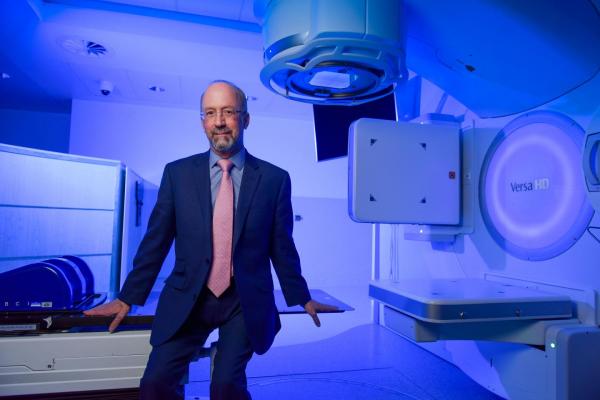
Professor David Sebag-Montefiore (Image courtesy of the University of Leeds)
April 7, 2020 — An international panel of cancer experts has recommended a one-week course of radiotherapy and delaying surgery as the best way to treat patients with bowel cancer during the COVID-19 pandemic.
The short course of treatment involves higher-intensity radiation rather than five weeks of radiotherapy coupled with chemotherapy. Surgery, which normally happens one to two weeks after radiotherapy, can be safely delayed by up to 12 weeks, say the expert panel.
This approach, based on the latest research evidence, will maintain the best chance of successfully treating the disease while at the same time reducing the side effects of treatment and the risks of COVID-19 infection.
People with bowel cancer are more susceptible to severe complications from COVID-19 because their immune system is weakened. Shorter-course radiotherapy avoids the need for chemotherapy, which further suppresses the immune system. It also means significantly fewer hospital appointments, allowing patients to maintain social distancing rules.
David Sebag-Montefiore, professor of clinical oncology at the University of Leeds and honorary clinical oncologist with the Leeds Teaching Hospitals NHS Trust, who led the expert panel, said: "The COVID-19 pandemic is a global emergency and we needed to work very quickly to identify changes that would benefit patients. Our recommendations were published 20 days after our first meeting. This process normally takes many months, if not years."
Writing in the journal Radiotherapy and Oncology, the panel, made up of cancer experts from across Europe, say it is also possible that hospitals may struggle to offer the current treatment approaches as COVID-19 impacts on hospital staffing levels.
The expert panel's recommendations can be found here: https://www.thegreenjournal.com/article/S0167-8140(20)30173-0/pdf
The 15- strong panel comprised researchers who led the defining studies. Their research shows that surgery can be safely delayed by 12 weeks. The chances of successful treatment are maintained and post-operative side effects are reduced. This allows surgery to be scheduled after the peak of the pandemic.
The recommendation to use shorter-course radiotherapy follows a major study, funded by the UK Medical Research Council and led by Sebag-Montefiore, which demonstrated the benefit of the one-week course of radiotherapy.
Sebag-Montefiore added: "Our guidelines will result in a very substantial change in treatment across the globe. During the COVID-19 pandemic, our patients will benefit from the use of an effective, shorter and safer radiotherapy treatment."
For more information: www.leeds.ac.uk
Related Coronavirus Content:
CDC Officially Recommends Public to Wear Face Masks
Two Studies Use SIRD Model to Forecast COVID-19 Spread
Radiology Publishes First Case of COVID-19 Encephalopathy
VIDEO: Use of Telemedicine in Medical Imaging During COVID-19
VIDEO: How China Leveraged Health IT to Combat COVID-19
CDRH Issues Letter to Industry on COVID-19
Qure.ai Launches Solutions to Help Tackle COVID19
ASRT Deploys COVID-19 Resources for Educational Programs
Study Looks at CT Findings of COVID-19 Through Recovery
VIDEO: Imaging COVID-19 With Point-of-Care Ultrasound (POCUS)
The Cardiac Implications of Novel Coronavirus
CT Provides Best Diagnosis for Novel Coronavirus (COVID-19)
Radiology Lessons for Coronavirus From the SARS and MERS Epidemics
Deployment of Health IT in China’s Fight Against the COVID-19 Epidemic
Emerging Technologies Proving Value in Chinese Coronavirus Fight
Radiologists Describe Coronavirus CT Imaging Features
Coronavirus Update from the FDA
CT Imaging of the 2019 Novel Coronavirus (2019-nCoV) Pneumonia
CT Imaging Features of 2019 Novel Coronavirus (2019-nCoV)
Chest CT Findings of Patients Infected With Novel Coronavirus 2019-nCoV Pneumonia
 October 07, 2026