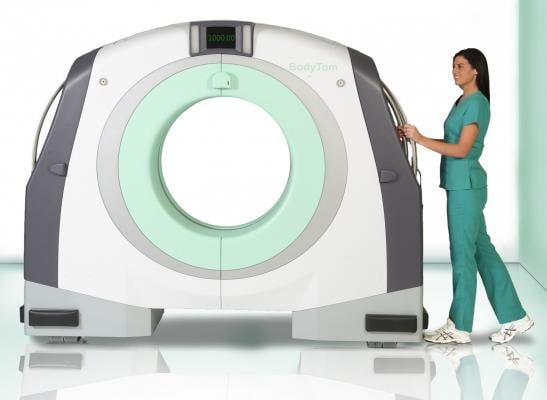
October 27, 2016 — Samsung announced in September that the Willis-Knighton Cancer Center in Shreveport, La., added BodyTom CT, the world’s first portable, full-body, 32-slice computed tomography (CT) scanner, to its brachytherapy suite.
Willis-Knighton Cancer Center’s five radiation oncologists and eight medical physicists are incorporating BodyTom into treatment workflow processes that daily serve about 100 patients, including up to six brachytherapy treatments. BodyTom eliminates the need to transfer patients to a CT simulator room, eliminating the challenges associated with moving patients, including risk of displacing brachytherapy applicators and adding time to brachytherapy procedures. The increased efficiency has enabled Willis-Knighton Cancer Center to increase use of its CT simulator room for patients who also require imaging as part of their treatment modality.
“Due to the large size of our brachytherapy practice, our CT simulator was incapable of keeping up with demand,” said Lane R. Rosen, M.D., Willis-Knighton Cancer Center director of radiation oncology. “Efficiency is vital to maintaining our status as one of the country’s leading brachytherapy practices, and based on early observations, adding the BodyTom scanner to our brachytherapy suite has reduced treatment times by 20 to 30 minutes per patient. Additional benefits include increasing comfort, ease and safety for patients as well as enhancing accuracy. We are quite pleased with the results we’ve seen to date.”
BodyTom is a self-shielded, multi-departmental imaging solution capable of transforming any room in the hospital into an advanced imaging suite. The system features an 85cm gantry and a 60cm field of view, the largest field of view available in a portable CT scanner, according to Samsung. Designed to accommodate patients of all sizes, BodyTom provides point-of-care imaging wherever high-quality CT images are needed, including the operating room, intensive care unit, radiation oncology suites and the emergency department. The combination oradf rapid scan time, flexible settings and immediate image viewing makes the BodyTom a valuable tool to any facility needing versatile real-time portable imaging.
Radiation oncologists use brachytherapy to treat forms of prostate, lung, breast, colorectal and gynecologic cancers. Radioactive sources are temporarily inserted inside tumors or areas of interest; this process enables precise delivery of high doses in a short time. The BodyTom produces high-quality, 3-D images to aid this process and can also be used to double-check the placement of radioactive implants, and make adjustments as necessary, without moving the patient.
The BodyTom portable CT scanner is designed to help medical physicists and radiation oncologists map out a course of treatment at the point of care, in real time. Clinical studies have shown BodyTom CT to be a safe, highly precise tool for aiding the insertion of implants in anatomically complex procedures such as spinal surgery,1 enhancing outcomes.2
The BodyTom was on display in Samsung’s booth the American Society for Radiation Oncology (ASTRO) 58th Annual Meeting, Sept. 25-27 in Boston.
For more information: www.neurologica.com/bodytom

 October 07, 2026