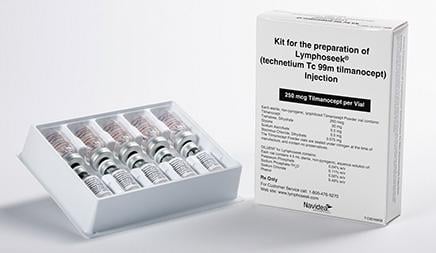
Image courtesy of Navidea Biopharmaceuticals
December 11, 2015 — Navidea Biopharmaceuticals Inc. announced that results from an investigator-initiated imaging study demonstrated Lymphoseek (technetium Tc 99m tilmanocept) injection reduced imaging time by more than 50 percent in sentinel lymph node biopsy procedures in malignant melanoma compared to Tc99m sulfur colloid (SC).
This finding suggests hospitals and oncology treatment teams can achieve greater patient throughput and workflow efficiencies utilizing Lymphoseek. Results of the study — conducted at the Thomas Jefferson University Hospitals and led by Charles M. Intenzo, M.D., professor of radiology, director, nuclear medicine and molecular imaging in the Department of Radiology — were presented at the Radiological Society of North America annual meeting (RSNA 2015) in Chicago.
A total of 34 consecutive patients with malignant melanoma underwent sentinel lymph node (SLN) mapping with Lymphoseek. Patients received the Lymphoseek dose in four intradermal administrations around the tumor site. Images were acquired at intervals up to 40 minutes after injection, which is the department’s standard-of-care protocol used for Tc99m Sulfur Colloid (SC) procedures. This site’s previous experience showed that SC injections required 40 to 45 minutes after injection for visualization of all lymph nodes in patients with malignant melanoma.
Using Lymphoseek, the results show that in all 34 patients, all lymph nodes seen in the final 40-minute image were identified in the 20-minute image, providing rapid and stable localization and identification of the sentinel nodes. The study concludes that in malignant melanoma, SLN mapping with Lymphoseek involves a total imaging time of 20 minutes, which is one-half of the time required for Tc99m SC. From a clinical perspective, the authors conclude that utilizing Lymphoseek is more time-efficient than SC by facilitating patient throughput and expediting subsequent transport to the operating room.
For more information: www.lymphoseek.com
 October 06, 2026