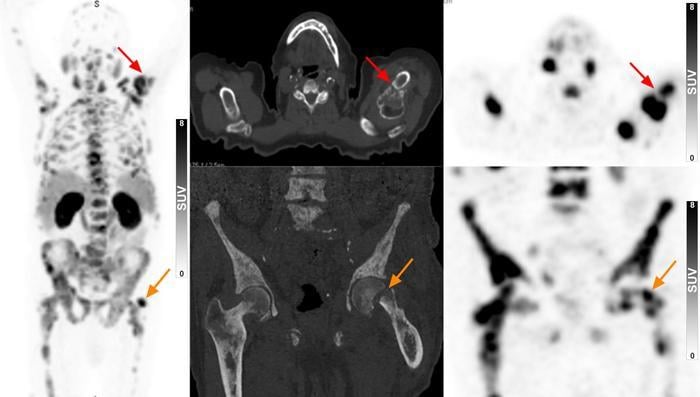
68Ga-PSMA-11 PET/CT of an 82-year-old male patient with bone pain and PSA levels of 960 ng/ml. 68Ga-PSMA-11 PET/CT of an 82-year-old male patient with bone pain and PSA levels of 960 ng/ml. The patient was referred to PET/CT without a biopsy. In addition to identifying a primary tumor in the prostate and metastatic skeletal spread, PET/CT data pointed out the presence of pathological fractures of the left humerus and left femur (arrows), and the patient was referred immediately to radiotherapy for the humeral lesion and surgery for the femoral lesion. Image created by M. Kesler anad D. Cohen et al, Department of Nuclear Medicine Tel Aviv Sourasky Medical Center, Tel Aviv, Israel.
August 15, 2023 — In elderly patients with suspected prostate cancer, PSMA PET/CT can diagnose advanced disease and aid in therapy selection without the need for a biopsy. Published in the July issue of The Journal of Nuclear Medicine, this new research demonstrates how imaging with PSMA PET/CT can potentially reduce the number of prostate biopsies and associated complications in the elderly while providing accurate staging data.
68Ga-PSMA PET/CT has gained acceptance as a highly sensitive and specific imaging modality for evaluating the extent of disease in prostate cancer patients. In general, PSMA PET/CT is indicated when intermediate or high-risk cancer has been found on biopsy. In elderly patients, however, the procedure of prostate biopsy may be associated with longer hospital stay and post-biopsy complications such as infection, bleeding or urinary retention.
“Due to the risks of biopsy for elderly patients, they are occasionally referred for PSMA PET/CT without a pre-imaging confirming biopsy,” stated Einat Even-Sapir, MD, PhD, head of the Department of Nuclear Medicine at Tel Aviv Sourasky Medical Center and professor of imaging at Tel Aviv University in Tel Aviv, Israel. “In our study we sought to determine the rate, clinical characteristics, and PET-based stage of elderly patients referred for PSMA PET/CT without biopsy and explore whether their biopsy status affected therapeutic approach.”
One hundred consecutive patients at least 80 years old who underwent staging with 68Ga-PSMA-11 PET/CT were included in the study. For each patient, researchers documented whether pre-imaging biopsy was performed, the clinical characteristics, the PET-based staging parameters, and the primary therapy received.
Thirty-four percent of patients in the study had no pre-imaging biopsy. Compared with patients who did have a pre-imaging biopsy, these patients were older with worse clinical status and had higher PSA levels. On 68Ga-PSMA-11 PET/CT, all patients without pre-imaging biopsy were shown to have avid disease, with trends toward higher rates of bone metastases and overall advanced disease. Similar proportions of patients with and without pre-imaging biopsy were referred for hormonal therapy. In contrast, 63 percent of patients with biopsy were referred for radiotherapy after imaging, while only 8.8 percent of patients without pre-imaging biopsy were referred for radiotherapy.
“The results of the current study indicate that 100 percent of the elderly patients who were referred for PSMA PET/CT on the basis of clinical suspicion only were found to have avid disease. Given that positive PSMA PET/CT results usually indicate clinically significant rather than clinically insignificant prostate cancer, and together with the insignificant negative effect of radiation exposure in elderly patients, the practice of waiving the need for pre-imaging biopsy when the clinical suspicion is high proves to be effective and to have no apparent negative cost,” noted Even-Sapir.
For more information: www.snmmi.org

 October 07, 2026