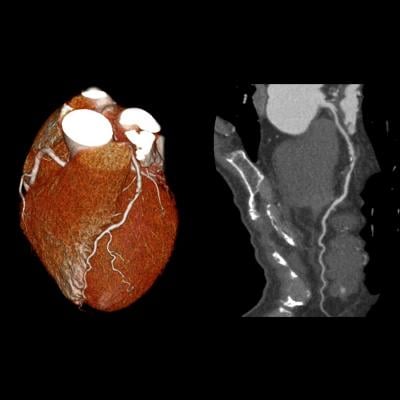
March 14, 2017 — Noninvasive computed tomography (CT) angiography and stress tests can help predict which patients are likely to suffer a heart attack or other adverse cardiovascular event, according to a new study appearing online in the journal Radiology.
Cardiovascular disease is a leading cause of death worldwide. Bypass surgery or stent placement is often recommended in people with certain degrees of coronary arterial narrowing, or stenosis, but recent studies have shown that many of these patients do just as well with medical therapy. A key factor in treatment decisions is the hemodynamic significance of the lesion, meaning the degree to which the lesion is blocking blood from getting to areas of the heart.
“Previous studies show that a lesion is hemodynamically significant if there is a significant blood pressure drop corresponding to a big reduction in blood flow across the stenosis,” said study author João A.C. Lima, M.D., from Johns Hopkins Hospital and School of Medicine in Baltimore. “If plaque has those characteristics, the patient should be targeted for intervention, be it with a stent or downstream bypass surgery.”
A combination of invasive coronary angiography (ICA) and stress tests with single photon emission tomography (SPECT) myocardial imaging has been the gold standard for making these determinations, with ICA showing the blockages and SPECT the perfusion, or penetration of the blood into the tissue. However, ICA requires the use of a catheter that is threaded from a puncture point in the groin all the way up to the heart.
“Invasive angiography is generally safe, but it can cause vascular problems in a significant number of patients, most commonly at site of the puncture,” Lima said. “In rare cases, it can cause strokes or heart attacks. These risks are not trivial.”
The ICA/SPECT approach can also be expensive, as it often necessitates hospitalization for the patient.
“The traditional approach with invasive catheterization requires that patients go to the hospital, get a catheter inserted into their leg and go in for the nuclear SPECT study on a different day,” said study coauthor Marcus Chen, M.D., from the National Institutes of Health in Bethesda, Md. “Now with just one noninvasive test we can get two important but different pieces of information about the coronary arteries.”
The researchers set out to determine if combined CT angiography (CTA) and CT myocardial stress perfusion imaging (CTP) could demonstrate similar or superior ability to ICA/SPECT in predicting future adverse events.
They compared the invasive and noninvasive approaches in 379 patients who were referred for ICA from November 2009 to July 2011. The researchers looked at the ability of both techniques to predict whether or not a future major adverse cardiac event (MACE), such as a heart attack, revascularization, arrhythmia or hospitalization for chest pain or congestive heart failure would occur.
Fifty-one patients, or 13.5 percent, experienced one or more major adverse cardiac events, including 49 revascularizations, five myocardial infarctions, one cardiac death, nine hospitalizations for chest pain or congestive heart failure, and one arrhythmia.
Both techniques proved to have similarly high values for predicting MACE at two years after presentation and event-free survival. The two-year MACE-free rates for combined CT angiography and CT perfusion findings were 94 percent negative for coronary artery disease (CAD) versus 82 percent positive for CAD and were similar to combined ICA/SPECT findings (93 percent negative for CAD vs. 77 percent positive for CAD).
“The key finding of our study is that both techniques are equally effective in identifying which patients are going to have trouble down the road,” Lima said. “The noninvasive option should be a preferred or at least strongly considered option by cardiologists and radiologists managing these patients because it is safer and less expensive, and patients like it better.”
Obstacles remain before the noninvasive approach can achieve more widespread use, including the lack of a reimbursement code for stress CT perfusion. But the study indicates that the technique is relatively easy to incorporate into existing practices: Fifteen of the 16 centers in the trial had never done the procedure before, according to Chen, and all were all able to learn it effectively.
Watch the video "CT for Chest Pain Evaluation in The Emergency Department."
For more information: www.pubs.rsna.org/radiology

 October 07, 2026