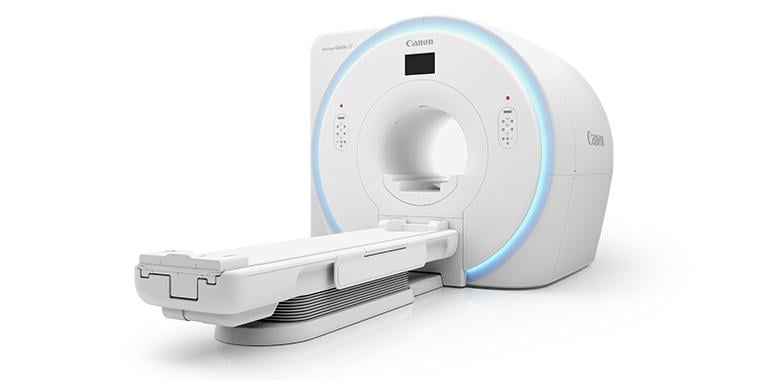
April 30, 2021 — Canon Medical is bringing the power of accessible artificial intelligence (AI) for improved image quality to more patients with expanded clinical indications for 3T MR. Advanced intelligent Clear-IQ Engine (AiCE) Deep Learning Reconstruction (DLR) can now be used for 96 percent of all procedures using the Vantage Galan 3T MR system, expanding from previously FDA-cleared brain and knee indications to a vastly larger number of clinical indications, from prostate to shoulders, including all joints, cardiac, pelvis, abdomen and spine.
AiCE was trained using vast amounts of high-quality image data, and features a deep learning neural network that can reduce noise and boost signal to quickly deliver sharp, clear and distinct images, allowing clinicians to boost image quality, performance, productivity and throughput on a whole new scale.
“With this expansion of AiCE, Canon Medical now offers advanced AI technology on its 1.5T and 3T MR systems,” said Mark Totina, managing director, MR Business Unit, Canon Medical Systems USA, Inc. “Canon Medical remains committed to making images easy to read and acquire, and this expansion further demonstrates our commitment to offering accessible AI that clinicians can use to make the greatest impact on patient care.”
With the expansion of indications, Canon Medical’s AiCE Challenge has also expanded. To see if you can tell the difference between 1.5T AiCE and traditional 3T image quality, take the AiCE Challenge today.
As part of the original AiCE Challenge, radiologists and technologists were asked if they could tell the difference between images taken on the Vantage Orian 1.5T system using AiCE with standard 3T MRI images with the same acquisition protocol for both scanners. Half of the time respondents had difficulty differentiating between 3T images without AiCE and Orian 1.5T images with AiCE applied. This next phase of the challenge will focus on body imaging, where the previous challenge focused on brain and knee images.
For more information: global.medical.canon

 October 08, 2026