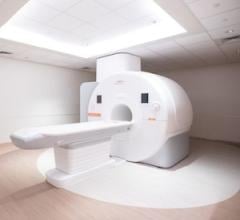
July 22, 2020 — Canon Medical Systems USA, Inc. has received 510(k) clearance on its Advanced intelligent Clear-IQ Engine (AiCE) for the Vantage Orian 1.5T MR system, continuing to expand access to its new Deep Learning Reconstruction (DLR) technology. This technology, which is also available on the Vantage Galan 3T MR system and across a majority of Canon Medical’s CT product portfolio, uses a deep learning algorithm to differentiate true signal from noise so that it can suppress noise while enhancing signal, forging a new frontier for image reconstruction.
“The Vantage Orian was designed to increase productivity while ensuring patient comfort and delivering uncompromised clinical confidence,” said Jonathan Furuyama, managing director, MR Business Unit, Canon Medical Systems USA, Inc. “Now with the addition of AiCE, we’re elevating MR imaging capabilities for our customers by bringing the power of AI to routine imaging, allowing them to use techniques that weren’t clinically practical before.”
To showcase how AiCE can help clinicians obtain higher signal-to-noise ratio, Canon Medical has launched an image challenge where visitors can compare images taken on the Vantage Orian 1.5T system using AiCE with standard 3T MRI images. To take the challenge and compare the image quality, click here.
AiCE was trained using vast amounts of high-quality image data, and features a deep learning neural network that can reduce noise and boost signal to quickly deliver sharp, clear and distinct images, further opening doors for advancements in MR imaging. Capabilities include:
- High quality images: AiCE allows for the differentiation of true signal from noise through deep learning innovation to match the spatial resolution and low-noise properties of advanced scanning and reconstruction, while maintaining the true structure of the anatomy. Using AiCE may help clinicians expand clinical capabilities beyond traditional 1.5T MR.
- Seamless integration into routine practice: AiCE is the world’s first fully integrated deep learning reconstruction for MR, and is built directly into the scan protocols for seamless workflow.
- Preferred AiCE MR image quality over non-AI reconstruction images: Following a blinded image comparison of AiCE DLR reconstructed images with images reconstructed with conventional methods without AiCE, physicians stated preference for AiCE images for clarity and resolution.
For more information: https://global.medical.canon

 October 07, 2026