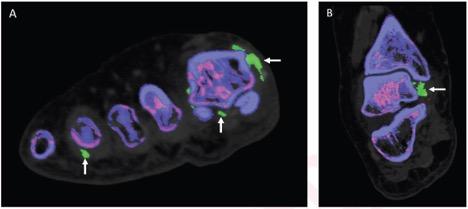
83-Year-Old Woman With No History of Gout and Serum Uric Level of 9.2 mg/dl, Who Underwent DECT (2013) of Right Foot Due to Right Ankle Pain and Swelling: (A) Coronal image through forefoot and (B) coronal image through ankle. Green pixels (arrows) observed in association with first and fourth metatarsophalangeal joints (A) and tibiotalar joint (B), consistent with monosodium urate deposition. Examination interpreted as positive for gout. Final clinical diagnosis by referring service was gout. Confirmatory

January 28, 2022 — According to an article in ARRS’ American Journal of Roentgenology (AJR), technological improvements, clinical practice changes, and growing experience among radiologists and referrers alike are contributing to the evolving role of dual-energy CT (DECT) in gout workup.

When comparing DECT examinations performed for gout in 2013 and 2019, the frequency of equivocal interpretations was significantly lower in 2019, “possibly related to interval technologic improvements,” lead researcher Francis I. Baffour, M.D., of Mayo Clinic in Rochester, MN concluded. “Negative examinations were less frequently followed by joint aspirations in 2019, possibly reflecting increasing clinical acceptance of the DECT results.”

Baffour and colleagues’ retrospective study included 100 consecutive adult patients who underwent DECT for gout evaluation in each of two periods, beginning in March 2013 and September 2019. DECT examinations in 2013 used a second-generation scanner (140 kV with 0.4 mm tin filter); in 2019, a third-generation scanner (150 kV with 0.6 mm tin filter) with improved spectral separation was used. Original DECT reports were classified as positive, negative, or equivocal for monosodium urate crystals indicative of gout. Joint aspirations occurring post-examination were recorded via medical record review.

Compared with the 2013 DECT examinations performed for suspected gout, those performed in 2019 had a significantly lower frequency of equivocal interpretations (16.0% vs. 33.0%, p<.001). Moreover, joint aspiration was significantly less likely to be performed after negative DECT interpretations in 2019 than in 2013 (2.1% vs. 17.4%, p=.02).

“The findings indicate an evolving role for DECT in the evaluation of gout following an institution’s routine adoption of the technology for this purpose,” the authors of this AJR article added.

For more information: www.arrs.org

Related content:

Advances in CT to Enhance Radiation Therapy Planning

New Study Shows Value of Low-concentration Iodine When Paired with Dual-Energy CT and DL Technique

Related Content

News | Breast Imaging

March 10, 2026 — QT Imaging Holdings has received U.S. Food and Drug Administration (FDA) 510(k) clearance for an ...

Time March 13, 2026
arrow
News | Radiology Business

March 12, 2026 — DelveInsight's has released its latest Diagnostic Imaging Equipment Market Insights report. The in ...

Time March 13, 2026
arrow
News | Enterprise Imaging

Mar. 9, 2026 — GE HealthCare recently announced that View, the viewer within the Genesis Radiology Workspace, has ...

Time March 12, 2026
arrow
News | Lung Imaging

March 11, 2026 — Noah Medical has announced the publication of the MATCH 2 study in the international, peer-reviewed ...

Time March 12, 2026
arrow
News | Computed Tomography (CT)

March 5, 2026 — At ECR 2026, Royal Philips introduced Rembra, its next-generation radiology CT system designed for the ...

Time March 09, 2026
arrow
News | FDA

Mar. 9, 2026 — GE HealthCare's View, the powerful viewer within the Genesis Radiology Workspace, has received 510(k) ...

Time March 09, 2026
arrow
Feature | Artificial Intelligence | Kyle Hardner

Once considered an adjunct brain cancer therapy and a last-resort treatment, noninvasive radiosurgery has evolved ...

Time March 09, 2026
arrow
News | HIMSS

March 5, 2026 — At the Health Information and Management Systems Society (HIMSS) Conference & Exhibition 2026 in Las ...

Time March 06, 2026
arrow
News | Radiology Business

March 5, 2026 — Cassling is now accepting applications for the 2026 Imaging for Impact Award, a national recognition ...

Time March 05, 2026
arrow
News | Artificial Intelligence

March 2, 2026 — RadNet, Inc. has acquired Gleamer SAS, a radiology AI company based in Paris, France. Gleamer will be ...

Time March 03, 2026
arrow
Subscribe Now