News | Magnetic Resonance Imaging (MRI) | November 17, 2021

University of Michigan Health System installs company’s smallest, most lightweight scanner, which combines 0.55T field strength with deep learning technologies

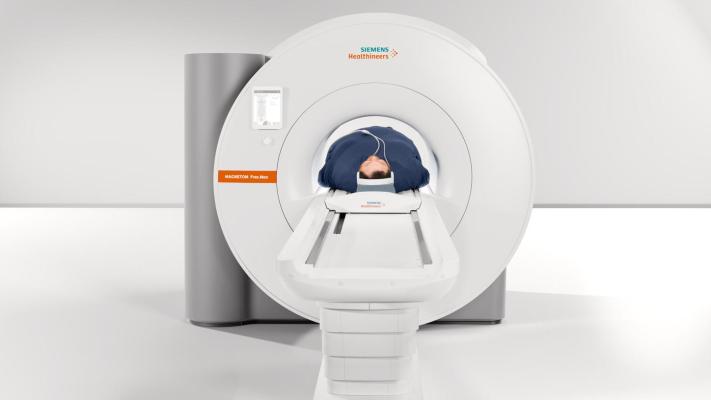
The University of Michigan Health System recently became the first U.S. healthcare institution to install the Magnetom Free.Max, a 0.55 Tesla (0.55T) magnetic resonance (MR) imaging scanner with deep learning technologies and advanced image processing.

November 17, 2021 — The University of Michigan Health System recently became the first U.S. healthcare institution to install the Magnetom Free.Max, a 0.55 Tesla (0.55T) magnetic resonance (MR) imaging scanner with deep learning technologies and advanced image processing.

The first and only 80 cm wide-bore system, the Magnetom Free.Max extends access to severely obese and claustrophobic patients and offers them an improved experience. At under 3.5 tons and less than 80 inches high, it is the most lightweight, compact whole-body MR scanner ever offered by Siemens Healthineers. Its new magnet design requires less than 1 liter of helium, contributing to reduced infrastructure and lifecycle costs. Deep Resolve algorithms perform targeted denoising and employ deep learning to deliver sharper, higher-resolution images. The scanner’s myExam Companion workflow solution incorporates artificial intelligence to help the user navigate the examination more efficiently.

“With this acquisition of the Magnetom Free.Max, University of Michigan Health will collaborate with Siemens Healthineers to vigorously explore the broader capabilities of mid-field magnetic resonance imaging with advanced image acquisition and reconstruction technologies, with the ultimate goal of expanding access to MRI,” said Vikas Gulani, M.D., Ph.D., chair of the Department of Radiology at Michigan Medicine.¹

“Siemens Healthineers is pleased to provide the University of Michigan Health System with the Magnetom Free.Max, with its host of unique features that have the potential to bring advanced magnetic resonance imaging to greater numbers of patients,” said Jane Kilkenny, vice president of magnetic resonance at Siemens Healthineers North America.

For more information: siemens-healthineers.us/free-max

Reference

¹ Title provided for identification purposes only. The views and opinions expressed are those of the individual and do not necessarily reflect the positions of the University of Michigan.

Additional RSNA21 conference coverage can be found here.


Related Content

News | FDA

Mar. 9, 2026 — GE HealthCare's View, the powerful viewer within the Genesis Radiology Workspace, has received 510(k) ...

Time March 09, 2026
arrow
Feature | Artificial Intelligence | Kyle Hardner

Once considered an adjunct brain cancer therapy and a last-resort treatment, noninvasive radiosurgery has evolved ...

Time March 09, 2026
arrow
News | HIMSS

March 5, 2026 — At the Health Information and Management Systems Society (HIMSS) Conference & Exhibition 2026 in Las ...

Time March 06, 2026
arrow
News | Radiology Business

March 5, 2026 — Cassling is now accepting applications for the 2026 Imaging for Impact Award, a national recognition ...

Time March 05, 2026
arrow
News | Artificial Intelligence

March 2, 2026 — RadNet, Inc. has acquired Gleamer SAS, a radiology AI company based in Paris, France. Gleamer will be ...

Time March 03, 2026
arrow
News | HIMSS

March 3, 2026 — MedDream will present its cloud-native, AI-ready universal DICOM viewer in the Amazon Web Services (AWS) ...

Time March 03, 2026
arrow
News

Feb. 26, 2026 — GE HealthCare and UCSF Health have announced a 10-year Care Alliance collaboration focused on ...

Time March 02, 2026
arrow
News | Remote Viewing Systems

Feb. 26, 2026 — DeepHealth, Inc., a provider of AI-powered health informatics and a wholly owned subsidiary of RadNet ...

Time February 27, 2026
arrow
News | Radiology Education

The American Society of Radiologic Technologists (ASRT) has named 109 individuals from across the country to participate ...

Time February 24, 2026
arrow
Feature | Information Technology | Dhruv Chopra

Radiology is a cornerstone of modern medical diagnostics, but today it stands at an inflection point. Pressures ...

Time February 24, 2026
arrow
Subscribe Now