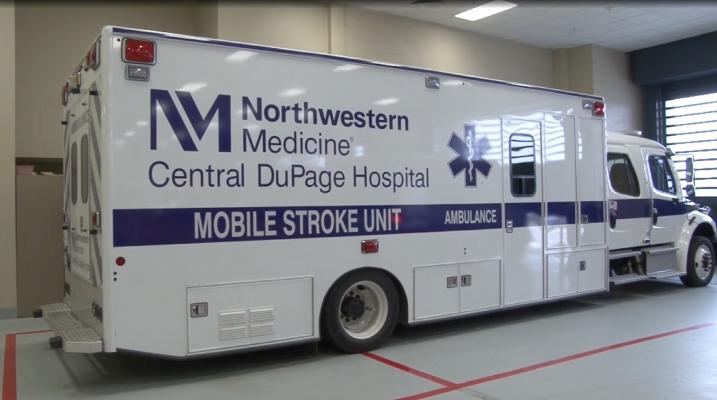
May 7, 2018 — A new data analysis of the Northwestern Medicine Mobile Stroke Unit (MSU) found the specialized ambulance provided life-saving treatment 30 minutes faster than traditional transport in its first year of operation. The analysis found, on average, the MSU delivered the clot-busting drug tPA to ischemic stroke patients 52 minutes after 9-1-1 dispatch, compared to an average of 82 minutes for patients transported via ambulance.
The latest tool in Northwestern Medicine's clinical offerings, the MSU is a specialized ambulance equipped with a 16-slice computed tomography (CT) scanner to take detailed images of the brain, a direct telemedicine connection to neurologists at Northwestern Medicine Central DuPage Hospital (CDH) and stroke-specific medications, including tPA.
Currently, tPA is the gold standard for the treatment of ischemic strokes caused by a clot. However, it cannot be given until a CT scan or other imaging can determine if the stroke is ischemic or hemorrhagic. The Mobile Stroke Unit allows clinicians to make that determination from the patient's driveway.
"Every minute the brain goes without oxygen, there is a 3.1 week acceleration of the natural aging process," said Harish Shownkeen, M.D., medical director of the Stroke and Neurointerventional Surgery Programs at Northwestern Medicine Central DuPage Hospital. "By treating stroke patients faster, we are greatly improving the odds patients will suffer minimal to no long term deficits."
The goal is to diagnose and treat stroke within the "Golden Hour", the first 60 minutes following onset of symptoms when patients have much better outcomes. A 2014 study in JAMA found that less than 1 percent of patients treated with tPA in the U.S. receive the life-saving medication within the "Golden Hour". During the first year of service, 27 percent of eligible Mobile Stroke Unit patients received tPA within one hour of onset of symptoms.
For patients, like Cynthia Reid from Glen Ellyn, Ill., rapid treatment in the MSU means walking out of the hospital instead of going to a post-acute care rehabilitation facility. One year after suffering what could have been a debilitating or deadly stroke, Reid's speech and memory have been fully restored. She is undergoing outpatient physical therapy to address residual numbness of her left hand. Reid says she is doing remarkably well, especially considering what could have happened.
"The Mobile Stroke Team at Central DuPage Hospital absolutely saved my life," said Reid. "They were able to give me the medication I needed right away, while also keeping me calm by reassuring me. If you think you might be having a stroke, I urge you to call 9-1-1 right away."
The first of its kind in Illinois and one of the largest in the nation, Northwestern Medicine Central DuPage Hospital's Mobile Stroke Unit can be directly dispatched by 9-1-1 to patients within the hospital's Emergency Medical Services (EMS) area. Due to the excellent results, Northwestern Medicine is working on innovative ways to expand the service to reach more patients in the far western suburbs of Chicago.
For areas outside the region, Northwestern Medicine is developing a secondary service area in which fire protection districts and ambulance services can request the MSU for patients who meet stroke criteria. Depending on the estimated arrival time, the Mobile Stroke Unit may go to the patient or arrange to meet an ambulance half-way.
"We are essentially bringing the hospital to the patient," said Mehr Mohajer-Esfahani, MSN, RN, program manager, Northwestern Medicine Central DuPage Hospital Mobile Stroke Unit. "Diagnosis and treatment begin in the Mobile Stroke Unit before the patient is transported to the closest comprehensive stroke center."
Watch the VIDEO: Creating and Operating a Mobile Stroke Unit
For more information: www.nm.org

 October 07, 2026