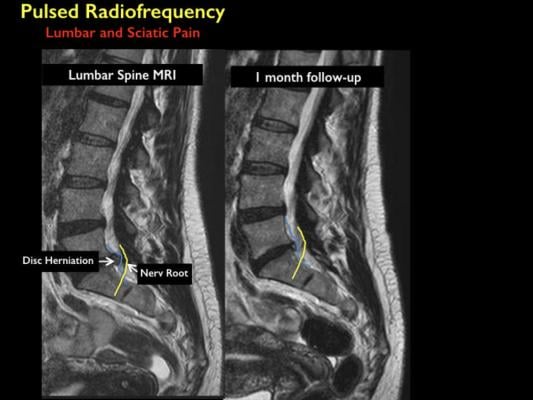
Lumbar spine MRI showing disc herniation and nerve root at baseline and one month after treatment
January 11, 2018 — The majority of patients were pain-free after receiving a new image-guided pulsed radiofrequency treatment for low back pain and sciatica, according to a study presented at the annual meeting of the Radiological Society of North America (RSNA), Nov. 26-Dec. 1 in Chicago.
Low back pain is an extremely common problem that affects at least 80 percent of the population at some point in their lifetime. It is the most common cause of job-related disability. Low back pain affects men and women equally.
Most back pain is short-term, but about 20 percent of people affected by acute low back pain go on to develop chronic low back pain lasting a year or more. A compressed and herniated disk, in which the rubbery cushion between vertebrae impinges on and irritates nearby nerves, is a major cause of low back pain that can radiate to the legs.
"The nerve root is a sensitive structure that when pinched becomes inflamed and causes pain," said lead investigator Alessandro Napoli M.D., Ph.D., an interventional radiologist at Sapienza University of Rome. "The body reacts with muscle constriction, which decreases the distance between vertebrae, and a vicious cycle is created."
The single-center prospective study included 80 patients experiencing at least three months of low back pain due to a herniated disk that had not responded to conservative treatments including exercise and medication.
The patients underwent a minimally invasive interventional radiology procedure in which, with the help of computed tomography (CT) imaging, a needle is guided to the location of the bulging disc and nerve root. A probe is then inserted through the needle tip and delivers pulsed radiofrequency energy to the area over a 10-minute period. Even without touching the disc, the pulsation serves to resolve the herniation.
"The probe delivers a gentle electrical energy, so there's no thermal damage," Napoli said. "The results have been extraordinary. Patients have been relieved of pain and resumed their normal activities within a day."
Of the 80 patients treated, 81 percent were pain-free one year after a single 10-minute treatment session. Six patients required a second pulsed radiofrequency session. Ninety percent of the patients were able to avoid surgical treatment.
"Following this treatment, inflammation and pain go away. With relaxation of the muscles, the distance between the vertebrae returns," Napoli explained.
Napoli said no patients experienced side effects after receiving the minimally invasive outpatient treatment.
"There's a big gap between conservative treatments for disc compression and herniation and surgical repair, which can lead to infection, bleeding and a long recovery period," Napoli said. "Evolving technologies like this image-guided treatment may help a substantial number of patients avoid surgery."
Co-authors are Roberto Scipione, M.D., Hans Peter Erasmus, M.D., Cristina Marrocchio, M.D., Susan Dababou, M.D., and Carlo Catalano, M.D.
For more information: www.rsna.org
Related Content
Key RSNA 2017 Study Presentations, Trends and Video

 October 07, 2026