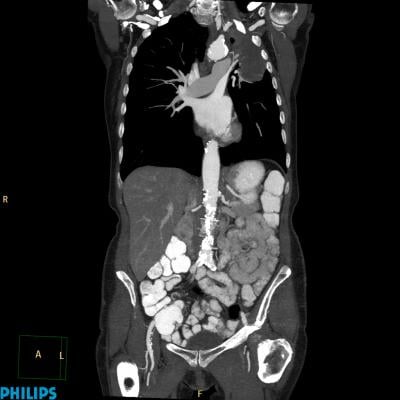
June 26, 2017 — A recent study appears to confirm the recommendations of the National Comprehensive Cancer Network (NCCN) Guidelines panel against chest computed tomography (CT) scans in breast cancer patients asymptomatic for distant metastases. The study, conducted by researchers at Siteman Cancer Center at Barnes-Jewish Hospital and Washington University School of Medicine, is published in the June issue of Journal of the National Comprehensive Cancer Network (JNCCN).
According to SEER data, more than 260,000 women were diagnosed with breast cancer in the United States in 2016, most of whom were diagnosed with early-stage (stage I or II) disease. For this demographic, the NCCN Clinical Practice Guidelines in Oncology (NCCN Guidelines) recommend standard imaging with bilateral mammography and ultrasound and, in some cases, breast magnetic resonance imaging (MRI). The NCCN Guidelines for Breast Cancer do not recommend chest computerized tomography (CT) scans in patients asymptomatic for distant metastases. Regardless, many asymptomatic patients undergo chest CT.
Using data from a prospective database, Barbara Dull, M.D., and colleagues studied records of more than 3,300 patients diagnosed with early-stage breast cancer between 1998 and 2012. They found that 11 percent of patients with stage I and more than 36 percent of patients with stage II breast cancer underwent chest CT within six months of diagnosis, despite NCCN Guidelines recommendations. Of these 683 patients, only nine were diagnosed with pulmonary metastases. However, benign pulmonary nodules were discovered in 175 patients.
“The overwhelming majority of nodules found in this study’s patient population classified as false positive results,” said Dull. “Not only do the costs of the chest CT and subsequent imaging and work-up put a cost constraint on the already burdened healthcare system, but the psychological impact of such results on a patient and their family is enormous.”
“I hope patients and their physicians are reassured by findings like these,” added Amy Cyr, M.D., corresponding author of the study. “Chest CT and other staging studies are of extremely low yield for identifying metastases in patients with early-stage breast cancer, and even for the 1.3 percent of patients in our cohort ultimately diagnosed with pulmonary disease, many were not diagnosed because of that original CT scan, but were instead diagnosed on scans as long as two years after diagnosis, suggesting even lower utility. Unfortunately, for the 26.9 percent of patients with positive CT scans (the vast majority of which were false positives), the subsequent evaluation needed not only raises healthcare costs and anxiety, but also has the potential to delay oncologic treatment.”
According to the study, patients who underwent staging chest CT were generally younger and more likely to have unfavorable tumor markers. However, there were no statistical differences between patients diagnosed with metastases and those with false positive results.
“Even with numerous guidelines and recommendations, staging studies are routinely performed in patients with stage I and II breast cancer. Despite NCCN recommendations, many patients with asymptomatic early-stage breast cancer continue to undergo chest CT as part of their initial evaluation. Adherence to the NCCN Guidelines and other evidence-based recommendations will spare patients unnecessary testing and, in an era of increasing healthcare costs, also curb excessive spending,” said Dull.
“Notwithstanding the publicized potential risks of radiation exposure and the disputable value of chest CT in early-stage breast cancer, referring clinicians still order it, not infrequently, based on anecdotal cases, concerns regarding legal ramifications or to satisfy insistent patients. At all stages of cancer care, including at presentation, during neoadjuvant or adjuvant therapy, and with advanced disease, evidence-based guidelines are needed to help direct treating physicians and their patients in selecting appropriate and indicated imaging studies,” said Pamela J. DiPiro, M.D., Dana-Farber/Brigham and Women’s Cancer Center, in a June JNCCN commentary titled, “Evidence-Based Guidelines: Optimizing Imaging in Cancer Care.”
For more information: www.jnccn.org
 October 09, 2026