

Greg Freiherr has reported on developments in radiology since 1983. He runs the consulting service, The Freiherr Group.
Blog | Radiology Imaging | October 26, 2016
Why We Love RSNA
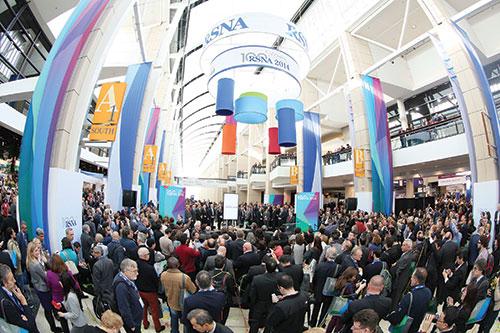
Photo courtesy of RSNA
Sure, the Radiological Society of North America’s (RSNA) annual meeting disrupts Thanksgiving. And the cold wind coming off Lake Michigan makes it all the harder to leave family and friends. But it’s easy to love RSNA, especially the exhibit floor.
It’s how the world should be. Like Epcot Center. Neat. Ordered. Futuristic, yet grounded in the present with lots of amazing equipment already in use. Ah, the air of reality with a sense of what is yet to come.
In the afterglow of our uniquely American holiday, RSNA gives us the chance to continue giving thanks as it lines up the best and brightest of radiology. It’s all the better when we consider the heyday of radiology, when radiologists were king, when they could demand from administrators what they wanted, and vendors obliged with tours of what they had for sale — and what they might have soon.
It was a fun time. There were lots of parties. Limos circled events, pulled to the curb, their drivers happy to take you wherever you wanted. There were kitschy freebies — like the glow sticks hundreds (maybe thousands) hung from their necks to celebrate the arrival of color Doppler. And free drinks.
Those days have passed. Like the early days of a romance turned into a 30-year marriage. And, like the object of that romance, RSNA is still easy to love.
Changing Times
As this year’s Nobel laureate of literature crooned in his youth, the times they are a-changin’. RSNA has changed, but it’s still the place to see what’s new in imaging. This year, like the many preceding, we will see vendors continue their decades-long affair with patient-centric imaging, featuring technologies aimed at coming up with diagnoses quicker and more cost-effectively. Write it off to value-based medicine. The days of bells and whistles are done.
Sharing the driver’s seat at RSNA 2016 will be advanced and established technologies, each vaunted for their efficiency and effectiveness. Spectral and dual-energy computed tomography (CT) will ride high on the shoulders of their ability to determine definitively what ails the patient. At a similar altitude will be 64-and 128-slice scanners, hoisted for their capacity to perform every mainstream CT study.
Enterprise imaging will expand the reach of radiology with new workflows, rules and virtual conferencing that promise to bridge the gap between radiologists and other specialists. Picture archiving and communication systems (PACS) will be more versatile and scalable with modules added à la carte.
We will see smaller, lighter weight, more maneuverable ultrasound and portable X-ray systems. Patient friendlier positron emission tomography (PET)/CTs will be in vogue.
Magnetic resonance (MR) will get faster, especially of the central nervous system. Wireless technologies will become more prevalent and impactful. The cloud will become more prominent. But security, on everyone’s minds after the frightening wave of internet attacks this fall, will cause even the most strident advocates of new age informatics to hesitate … a little.
Vapor On The Wane
The days of vaporware — works-in-progress that have little chance of getting to market soon — are waning. The competition that once drove vendors to prematurely unveil technologies has diminished, allowing us the time to appreciate how far imaging has come.
It’s amazing to me the innovation that has become old hat. We should revel in it — love how it has changed the practice of medicine, and how it may yet do so. This year breast tomosynthesis will continue efforts to leap from the diagnostic mainstream to screening. CT, having gone from horizontal to vertical with a product now cleared by the FDA, may change the practice of orthopedics.
Ultrasound will take another stab at contrast enhancement (CE), as elastography wends its way into routine practice. (While CE ultrasound probably won’t be demonstrated at RSNA, other forms of this modality will — and for the first time in the history of the exhibit floor.)
Yes, like Don Draper, new offerings at this year’s RSNA will depend a lot on presentation. And there will be more than enough hype to go around. But chances are good that what we see at booths will become reality. Eventually. And that, amid so much that has already been achieved, is glorious.
What’s not to love.
Editor's note: This is the final blog in a four-part series on State-of-the-art Radiology. The first blog, "When Will the Greatest Trend in Radiology Happen?" can be found here. The second blog, “The Promise Ahead for Radiology,” can be found here. The third blog, “How Imaging Could Change Medical Ethics,” can be found here.
Related Content

News | Artificial Intelligence
Oct. 7, 2026 – CARPL.ai has announced a collaboration with HOPPR that will give healthcare providers access to HOPPR's ...
 October 08, 2026

News | FDA
Oct.7, 2026 – MRI2CT Inc. has received FDA 510(k) clearance for NextMR, its AI powered imaging platform, for generating ...
October 07, 2026 
News | Information Technology
October 6, 2026 – Clearsense has introduced a cloud-based medical image archive designed to reduce the cost of ...
October 07, 2026 
News | PET-MRI
Sept. 29, 2026 —Yale New Haven Hospital has installed a state-of-the-art positron emission tomography/magnetic resonance ...
October 05, 2026 
Feature | Digital Pathology | Kyle Hardner
As recently as a decade ago, pathology technology was expected to become more expensive, larger and more precise. Yet in ...
October 02, 2026 
News | ASTRO
Sept. 29, 2026 — The American Society for Radiation Oncology (ASTRO) has named Siemens Healthineers the inaugural ...
September 29, 2026 
News | Computed Tomography (CT)
Sept. 17, 2026 — Royal Philips and Southwest Mississippi Regional Medical Center (SMRMC), which serves as the hub of ...
September 24, 2026 
News | Radiology Education
Sept. 16, 2026 — As urgent care centers and outpatient healthcare facilities expand their use of diagnostic imaging, the ...
September 17, 2026 
News | PET Imaging
Sept. 10, 2026 — Siemens Healthineers Molecular Imaging has completed a $43.6 million construction and renovation ...
September 14, 2026 
Feature | Artificial Intelligence | Kyle Hardner
A radiologist pulls up a chest CT scan flagged for a pulmonary nodule. One artificial intelligence (AI) tool writes its ...
September 09, 2026 © Copyright Wainscot Media. All Rights Reserved.

Subscribe Now