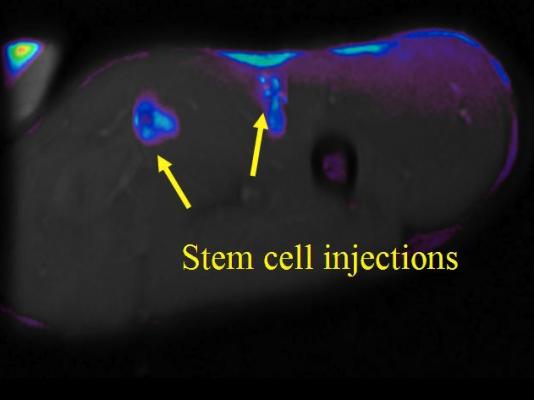
March 9, 2012 — Researchers have developed a method to label transplanted cells so they can be tracked by magnetic resonance imaging (MRI). In the future, as cell therapies become a more integral part of regenerative medicine and tumor treatment, there could be increased need to measure how many transplanted immune or stem cells reach their target.
A team combined three U.S. Food and Drug Administration (FDA)-approved drugs to form a complex that, when incubated in transplant cells, labeled nearly 100 percent of those cells for MRI in animal models.
"Less than 3 percent of intravenous transplanted cells get to their target. This brings up questions of cell dose, multiple doses, and dose timing and how to make cell therapy approaches more effective," said Joseph A. Frank, M.D., chief of the National Institute of Health (NIH) Clinical Center (CC) for radiology and imaging sciences laboratory of diagnostic radiology research said.
Cell death and distribution to other areas prevent most treatment cells from reaching the intended site. By using MRI to track cell arrival or homing to the desired site, researchers can compare dosage amounts and frequency for the most beneficial treatment.
In clinical practice, cell tracking is done with introduction of a radioisotope or implantation of an easily located reporter gene, but short half-life of isotopes, modification to the cell genome, and possibility of other toxicity limit these methods.
Frank and his team explored the use of ferumoxytol, a drug with iron oxide and magnetic properties that allow for MRI tracking. Two other drugs — heparin (with a strong negative charge) and protamine (with a strong positive charge) — allow for successful and smooth incorporation into the transplant cell. Ferumoxytol, heparin, and protamine form a complex through electrostatic interaction that, when incubated in transplant cells, label them for MRI tracking.
The complex contains concentrations of each drug substantially below recommended clinical doses and biodegrades safely through the iron metabolic pathway. Since these three drugs are used clinically, extensive safety testing should not be necessary and investigative new drug application evaluation should be shortened.
"The discovery of a technique to track cells developed for potential clinical use is one of many examples of the cutting-edge research at the NIH Clinical Center, which works to rapidly translate scientific discovery to clinical practice," said CC director John I. Gallin, M.D.
The technology, pending regulatory agency review, will be first tested in humans in an ongoing trial (NCT01172964) at the City of Hope Medical Center in Duarte, Calif. Supported by the California Institute of Regenerative Medicine, the study is testing the transplant of genetically engineered neural stem cells on patients with a type of brain tumor.
Researchers from the Henry Ford Hospital in Detroit, Mich., and the National Institute of Biomedical Imaging and Bioengineering, part of the NIH, also contributed to the Nature Medicine article.
For more information: clinicalcenter.nih.gov
 October 16, 2026