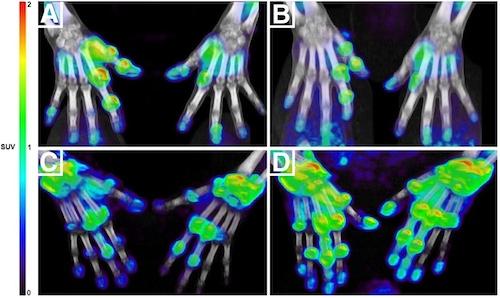
[11C]DPA-713 PET/CT images of hands of both clinical responder at baseline (A) and 4 wk of aTNF treatment (B) and nonresponder at baseline (C) and 4 wk of aTNF treatment (D).
Feb. 27, 2026 — A new targeted PET/CT tracer can detect treatment response in rheumatoid arthritis patients in as little as four weeks, and potentially even at the start of treatment, according to new research published in The Journal of Nuclear Medicine. Compared to the three to six months currently required to establish treatment efficacy, this new imaging technique could help determine the patients who are most likely to respond sooner, allowing non-responders to pursue more effective therapies.
Rheumatoid arthritis is a disease characterized by chronic inflammation of synovial tissue in joints, potentially leading to permanent damage to cartilage and bone, which can affect physical function and quality of life. Effective treatment is required to prevent or reduce the risk of permanent damage in accordance with standards of care.
Anti–tumor necrosis factor (aTNF) is a successful treatment for many patients with rheumatoid arthritis; however, it is only effective in 50 to 70 percent. As it can take three to six months before clinical response can be determined, objective and accurate tools are needed for early assessment of treatment response and patient stratification.
“Macrophages (a type of white blood cell), play a crucial role in the development and continuation of rheumatoid arthritis, and are a promising biomarker for assessment and monitoring of disease activity,” said Wouter van Binsbergen, MSc, MD, PhD, a student at the Amsterdam University Medical Center in Amsterdam, The Netherlands. “In our study, we utilized a new PET/CT imaging technique to quantify macrophages and determine their association with clinical disease activity.”
In the study, researchers conducted whole-body 11C-DPA-713 PET/CT scans on 20 rheumatoid arthritis patients undergoing aTNF treatment. Uptake of the 11C-DPA-713 tracer was quantified by determining the standardized uptake value in 44 joints at baseline and at four weeks. Mean SUVs of all joints and specific joint clusters were related to clinical evaluation after 26 weeks using linear regression analyses. Multivariable analyses, including both PET/CT and clinical evaluation, were also conducted.
Quantitative 11C-DPA-713 PET/CT measurements at baseline and four weeks after aTNF treatment showed significant association with clinical disease activity at 26 weeks. Furthermore, the addition of specific clinical data to SUV data of certain joints improved the potential predictive value in multivariable regression analyses at baseline and 4 weeks in specific instances.
“These findings show that non-invasive assessment and monitoring of macrophages using PET/CT has value to predict very early—potentially already at baseline—the outcome of anti-TNF treatment in rheumatoid arthritis patients,” said van Binsbergen. “On a larger scale, this work supports the clinical application of molecular imaging and use of novel immune cell targeting tracers for development of personalized treatment and stratification strategies in rheumatoid arthritis and beyond.”
The authors of “Macrophage-Targeted [11C]DPA-713 PET/CT Imaging for Early Therapeutic Evaluation of Anti–Tumor Necrosis Factor Treatment in Rheumatoid Arthritis” include Wouter Henk-Jan van Binsbergen, Jerney de Jongh, Alexandre E. Voskuyl, and Conny J. van der Laken, Department of Rheumatology and Clinical Immunology, Amsterdam UMC, VUmc, Amsterdam, The Netherlands; Maqsood Yaqub and Gerben J.C. Zwezerijnen, Department of Radiology and Nuclear Medicine, Amsterdam UMC, VUmc, Amsterdam, The Netherlands; Stéphanie van der Pas, Department of Epidemiology and Data Science, Amsterdam UMC, VUmc, Amsterdam, The Netherlands, and Methodology Section, Amsterdam Public Health Research Institute, Amsterdam, The Netherlands; and Dirkjan van Schaardenberg, Department of Rheumatology and Clinical Immunology, Amsterdam UMC, VUmc, Amsterdam, The Netherlands, and Department of Rheumatology, Reade, Amsterdam, The Netherlands.

 October 02, 2026