Photo: Butterfly Network
March 30, 2026 — Butterfly Network, Inc. has received clearance from the U.S. Food and Drug Administration (FDA) for a fully automated Gestational Age (GA) Tool integrated into its handheld ultrasound solution. This marks the first FDA-cleared blind-sweep ultrasound AI tool for estimating gestational age.
Despite its critical importance in guiding pregnancy care, timely, accurate gestational age assessment remains a gap in maternal care worldwide. In the U.S., nearly half of rural counties lack hospital obstetric services, and communities facing socioeconomic barriers have worse outcomes. Globally, 92% of maternal and neonatal deaths occur in low- and middle-income countries — many of which are preventable with access to basic imaging and earlier intervention. In these settings, limited access to ultrasound and trained specialists makes gestational age difficult to establish, particularly in emergent situations where patients may not know or be able to communicate it. Earlier identification enables clinicians to time key prenatal screenings, detect complications sooner, guide intervention, and ultimately improve outcomes for mothers and babies.
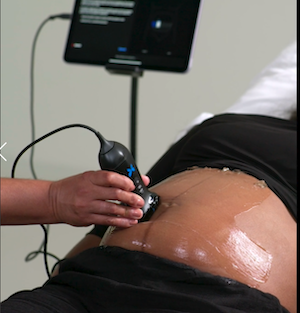
Butterfly’s GA Tool builds on deep-learning models developed by Jeffrey Stringer, MD, and team at the University of North Carolina at Chapel Hill, and uses an AI-powered blind-sweep method to deliver a reliable gestational age estimate in under two minutes via a fully automated, three-step process: enter fundal height, apply gel and perform guided sweeps. The tool is designed to minimize user variability and deliver rapid insights by eliminating the need for image capture, interpretation or fetal biometric measurements.
Trained on more than 21 million images across diverse patient demographics and care settings, the model delivers consistent results in patients between 16-37 weeks that are equivalent to sonographer-performed, biometry-based gestational age assessments. The solution is integrated directly into the Butterfly app and can be made available to caregivers across the globe.1
“Improving maternal health outcomes and expanding access to prenatal imaging has become an urgent priority, and Butterfly is proud to be the first to bring this type of technology to mothers globally,” said Sachita Shah, MD, Vice President, Global Health, Butterfly Network. “With FDA clearance, we now have an AI-powered tool that can help transform maternal health, both worldwide and here in the U.S., by addressing longstanding gaps in access to timely, reliable imaging and enabling earlier, more informed care.”
Butterfly’s Chief Business Officer, Steve Cashman, commented, “The GA Tool is built to address three critical use cases: enabling faster decisions in emergency settings when gestational age is unknown; expanding access in countries where maternal and neonatal mortality remains high; and improving prenatal ultrasound access in rural U.S. communities, where patients may otherwise travel hours for imaging. Ultimately, it’s about helping clinicians act faster, earlier, and with greater confidence, at critical moments and in any setting.”
Butterfly’s GA tool has already been deployed in Malawi and Uganda, and is made possible in part by a grant from the Gates Foundation. FDA clearance enables expedited pathways to expand across additional regions in Sub-Saharan Africa and comes at a timely moment in the United States, as federal rural health transformation initiatives drive investment in expanding access to care.
Organizations interested in partnering with Butterfly on maternal health programs can learn more at: www.butterflynetwork.com/global-health

 October 09, 2026