Technology | December 12, 2013

Technology helps eliminate variability in scanning

rsna 2013 ct systems toshiba adaptive technology aquilion prime one edition

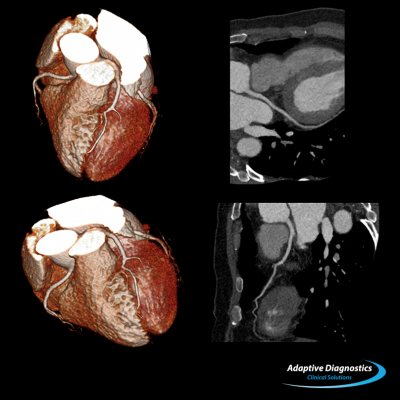
Cardiac CT image of a patient with atrial fibrillation using the Sure Cardio prospective arrhythmia detection software.


December 12, 2013 — Toshiba introduced its Adaptive Diagnostics computed tomography (CT) technology, which simplifies complex exams, lowers dose and improves diagnostic accuracy and reproducibility, at the Radiological Society of North America Annual Meeting (RSNA 2013).
 
Available on the Aquilion One, Aquilion One Vision Edition and Aquilion Prime, Toshiba’s Adaptive Diagnostics includes: 
  • SureSubtraction, which has the ability to remove bone and calcium from data sets while allowing clinicians to view tumors or arteries at risk. SureSubtraction is available for brain, bone, carotid and coronary artery exams. 
  • Metal Artifact Reduction (MAR), which removes streak artifacts in images due to metallic implants in the body.
  • Sure Cardio: Prospective with arrhythmia detection is a unique application that dramatically lowers patient dose during coronary CTA exams using a helical acquisition technique to provide one continuous image instead of multiple images. It automatically detects and adjusts to patients with irregular heartbeats, providing quicker, more conclusive exam results.
  • Variable Helical Pitch (vHP), which has the ability to automatically change an electrocardiogram (ECG)-gated to a non-ECG-gated acquisition, reducing IV contrast and radiation dose. vHP can significantly reduce radiation dose over the use of a single-gated pitch setting.
  • Dual Energy, which uses two energies during one CT scan, providing clinicians with more data to help quantify and characterize anatomy and lesions. As a result, exam times and radiation dose are both reduced.
These technologies are U.S. Food and Drug Administration (FDA)-pending.
 
For more information: www.medical.toshiba.com, www.rsna.org

Related Content

News | Breast Imaging

March 10, 2026 — QT Imaging Holdings has received U.S. Food and Drug Administration (FDA) 510(k) clearance for an ...

Time March 13, 2026
arrow
News | Lung Imaging

March 11, 2026 — Noah Medical has announced the publication of the MATCH 2 study in the international, peer-reviewed ...

Time March 12, 2026
arrow
News | Computed Tomography (CT)

March 5, 2026 — At ECR 2026, Royal Philips introduced Rembra, its next-generation radiology CT system designed for the ...

Time March 09, 2026
arrow
Feature | Artificial Intelligence | Kyle Hardner

Once considered an adjunct brain cancer therapy and a last-resort treatment, noninvasive radiosurgery has evolved ...

Time March 09, 2026
arrow
News | Artificial Intelligence

March 2, 2026 — RadNet, Inc. has acquired Gleamer SAS, a radiology AI company based in Paris, France. Gleamer will be ...

Time March 03, 2026
arrow
News | Ultrasound Imaging

March 2, 2026 — Esaote Group will officially launch the new MyLab E85 and MyLab C30 GTS Edition ultrasound systems at ...

Time March 02, 2026
arrow
News | Remote Viewing Systems

Feb. 26, 2026 — DeepHealth, Inc., a provider of AI-powered health informatics and a wholly owned subsidiary of RadNet ...

Time February 27, 2026
arrow
News | Magnetic Resonance Imaging (MRI)

Feb. 9, 2026 — MRIguidance, a MedTech company developing BoneMRI, a radiation-free bone imaging solution, has appointed ...

Time February 09, 2026
arrow
Feature | Cardiac Imaging | Kyle Hardner

Advances in coronary CT angiography (CCTA) have reached the point where image quality and AI capabilities are creating ...

Time February 06, 2026
arrow
News | Artificial Intelligence

Dec. 1, 2025 — Researchers at the University of California, Berkeley and University of California, San Francisco have ...

Time December 10, 2025
arrow
Subscribe Now