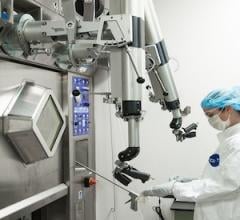
Prototype fluidic system for zirconium-89 purification. Image taken through a hot cell window at the Department of Radiology, University of Washington. Image courtesy of Matthew O’Hara, Pacific Northwest National Laboratory
March 14, 2019 — A team of researchers at the University of Washington announced they developed a new automated system for producing zirconium-89, a diagnostic radionuclide used for cancer tumor imaging.
Ideal for cancer tumor imaging, zirconium-89 lasts long enough in the body to find tumors and be imaged using positron emission tomography (PET) scans. Producing this useful radionuclide requires commonly found low-energy cyclotrons. The researchers produced zirconium-89 by proton beam irradiation of yttrium metal foils at the university’s 11-MeV cyclotron. They then transported the foils to researchers at the Pacific Northwest National Laboratory. The research team developed an automated dual column system that dissolved the foil targets and isolated the zirconium-89 from the dissolved yttrium target (and metal contaminants found in the yttrium metal). The process consistently generated a highly concentrated and pure solution of zirconium-89 that demonstrated excellent binding to deferoxamine, a radionuclide-binding ligand frequently used in tumor-targeting molecules. A patent has been applied for this novel purification method.
As the zirconium-89 supply is currently meeting demand, this is not an isotope sold through the U.S. Department of Energy (DOE) Isotope Program. However, this work, supported by the DOE Isotope Program, shows that zirconium-89 can be produced on lower energy (and more abundant) cyclotrons with a simple target design. The new automated approach could make high-quality batches more available and reduce exposure for radiation workers. Also, the approach offers a high chemical yield and low metal ion impurities, minimizing interference with tumor targeting.
This work was funded by the Department of Energy, Office of Science, Office of Nuclear Physics, Isotope Development and Production for Research and Applications subprogram. Funding was also provided by the National Institutes of Health. The researchers used the CT/Eclipse/111 cyclotron at the University of Washington.
For more information: www.science.energy.gov
Publications
J.M. Link, K.A. Krohn, and M.J. O’Hara, “A simple thick target for production of 89Zr using an 11MeV cyclotron.” Applied Radiation and Isotopes 122, 211 (2017). [DOI: 10.1016/j.apradiso.2017.01.037]
M.J. O’Hara, N.J. Murray, J.C. Carter, C.M. Kellogg, and J.M. Link, “Hydroxamate column-based purification of zirconium-89 (89Zr) using an automated fluidic platform.” Applied Radiation and Isotopes 132, 85 (2018). [DOI: 10.1016/j.apradiso.2017.10.048]
M.J. O’Hara, N.J. Murray, J.C. Carter, and S.S. Morrison, “Optimized anion exchange column isolation of zirconium-89 (89Zr) from yttrium cyclotron target: Method development and implementation on an automated fluidic platform.” Journal of Chromatography A 1545, 48 (2018). [DOI: 10.1016/j.chroma.2018.02.053]
M.J. O’Hara, N.J. Murray, J.C. Carter, C.M. Kellogg, and J.M. Link, “Tandem column isolation of zirconium-89 from cyclotron bombarded yttrium targets using an automated fluidic platform: Anion exchange to hydroxamate resin columns.” Journal of Chromatography A 1567, 37 (2018). [DOI: 10.1016/j.chroma.2018.06.035]

 October 21, 2026