Qure.ai announced that it has received breakthrough device designation from the Food and Drug Administration (FDA) Center for Devices and Radiological Health (CDRH) for its AI-powered Tuberculosis (TB) solution, qSpot-TB. This latest regulatory accolade for Qure.ai joins four FDA clearances and 61 European Union Medical Device Regulation (EU MDR) CE mark approvals over the last eighteen months. Image courtesy: Qure.ai
February 6, 2024 — Medical imaging AI innovator, Qure.ai, has received breakthrough device designation from the Food and Drug Administration's (FDA) Center for Devices and Radiological Health (CDRH) for its AI-powered Tuberculosis (TB) solution, qSpot-TB.
This latest regulatory accolade for Qure.ai joins four FDA clearances and 61 European Union Medical Device Regulation (EU MDR) CE mark approvals over the last eighteen months.
The qSpot-TB artificial intelligence (AI) is a second-read computer aided detection and diagnosis device that analyses Chest X-rays to localize all noted radiological signs suggestive of TB and provide an accompanying conclusion regarding the presence or absence of TB. This may support clinical workforces, especially during a recent uptick of TB incidences in developed nations including the United States.
Bunty Kundnani, Chief Regulatory Affairs Officer at Qure.ai, states, "Qure is committed to pushing the boundaries of AI medical innovation and follows rigorous legislative and regulatory processes in over 85 countries to ensure the highest standards of safety and efficacy of solutions. Achieving FDA and EU MDR clearances across multiple imaging modalities and global disease areas means that we can confidently support radiology workforces to prioritize patient cases quickly or expedite decision making.”
“The breakthrough device designation granted to Qure’s qSpot-TB device by the FDA marks a step-forward in the field of tuberculosis AI-assisted diagnosis. TB is a highly infectious disease affecting the lungs and is not just the premise of developing nations. Rates of TB in western societies such as UK and USA have ticked upwards following the Covid-pandemic, magnifying the need for continued focus on detection and screening. We look forward to working closely with the FDA on the onward breakthrough device regulatory process,” he adds.
"The increase in TB cases in USA is a reminder about the importance of collective global efforts to continue the fight against the disease until eliminated. We cannot let our guard down. Innovate technology is a crucial component for accelerated progress to successfully end TB globally”, said Professor Kenneth G. Castro, MD, FIDSA, Co-Director, Emory TB Center, Hubert Department of Global Health & Department of Epidemiology, Rollins School of Public Health, Division of Infectious Diseases, Department of Medicine, School of Medicine, Emory University.
After experiencing a continual decline for almost thirty years in the United States, TB cases saw an increase 2021/22. Although still less prevalent than before the Covid pandemic, the Centers for Disease Control and Prevention recorded 8,300 tuberculosis cases in 2022.i Similarly, in England, data from the UK Health Security Agency showed cases of TB increased by 7% in the first half of 2023 compared to the same timeframe in 2022.ii
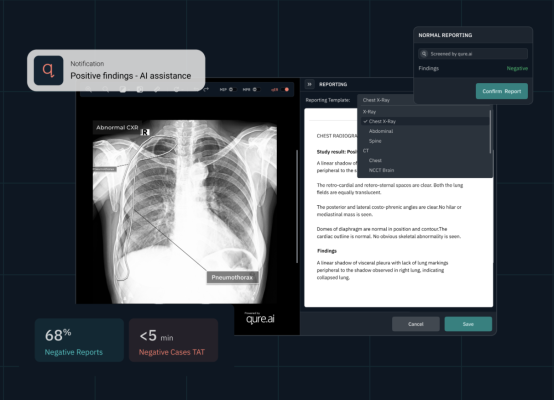
Other recent regulatory milestones for Qure.ai include FDA clearance for qXR-LN to identify and localise lung nodules; qXR-CRT to measure cardiothoracic ratio (CTR) value; qXR-PTX-PE to triage pneumothorax (PTX) and pleural effusion (PE) in emergency rooms / intensive care units (ICUs); and qER for head CT scans.
For more information: https://www.qure.ai/
References:
i. Centers for Disease Control and Prevention, Tuberculosis – United States, 2022
ii. UK Health Security Agency, TB cases continue to rise in England 2023

 October 08, 2026