Photo: Visiana
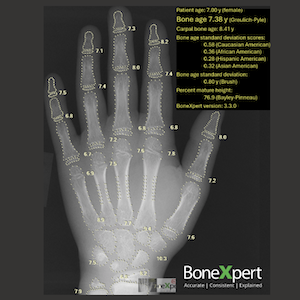
Sept. 29, 2026 — Visiana has announced that the U.S. Food and Drug Administration (FDA) has granted 510(k) clearance for BoneXpert, software that uses machine learning to determine bone age from hand radiographs. BoneXpert is cleared to support pediatric radiologists in assessing bone age in patients aged 2 to 21 years according to the Greulich-Pyle method.
Bone age assessment is a routine part of evaluating children with growth and pubertal disorders. Manual readings can vary considerably from one reader to the next, but BoneXpert removes this reader variability. BoneXpert determines the bone age and sends an annotated image to the patient's study in PACS, showing the contours of each bone it analyzed and their individual bone ages, so the pediatric radiologist can see how the result was reached. BoneXpert accepts radiographs of either hand, checks each image, and withholds the result when an image falls outside its valid scope. The radiologist remains responsible for the final assessment.
Multicenter Pediatric Study
The clearance was supported by a multicenter study at five U.S. clinical sites, comprising 1,285 images, each read independently by four pediatric radiologists. Using the average of three of the four manual readings as reference, BoneXpert and the fourth radiologist were each compared against the same reference. BoneXpert was found to be closer to the reference, with lower root mean square error (0.55 vs. 0.76 years) and fewer deviations of 1.5 years or more (1.7% vs. 6.4%)
The BoneXpert analysis takes place on a computer within the hospital network, so radiographs do not leave the institution, which simplifies HIPAA and security review.
Hans Henrik Thodberg, CEO and founder, says, "This clearance would not have been possible without the engagement of pediatric radiologists at the five U.S. sites, whose work documented BoneXpert's accuracy at every site. I also want to thank pediatric endocrinologist Dr. Judith Ross, whose collaboration established the evidence for BoneXpert's consistency over time – what often matters is not a single reading but how the bone age changes from one visit to the next. More broadly, it is the dedication of clinicians around the world, more than anything else, that has brought BoneXpert to where it is today."
BoneXpert has been in routine clinical use in Europe since 2009 and is now used worldwide. It carries the CE mark and is supported by more than 50 peer-reviewed publications.
BoneXpert will be released in the U.S in early October


 October 19, 2026