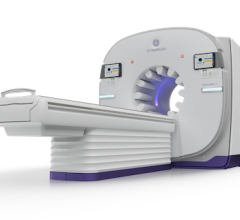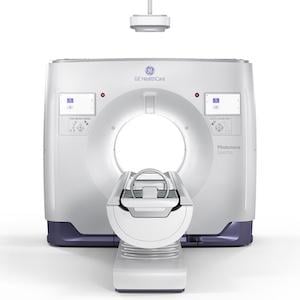
Photonova Spectra is an advanced photon-counting computed tomography (PCCT) system. (Photo: GE HealthCare)
Aug. 31, 2026 — GE HealthCare recently achieved the CE Mark for Photonova Spectra1, an advanced photon-counting computed tomography (PCCT) system with the company’s proprietary Deep Silicon detector technology. This expands access and enables clinical adoption of the technology in CE Mark–observing countries.
“We are proud to deliver this new generation of photon-counting CT to the clinicians and patients around the world it was intentionally designed to serve,” shares Chad Rowland, Executive Director, Global CT, GE HealthCare. “At its core is our Deep Silicon detector technology, which enables Photonova Spectra to capture remarkably detailed, spectral information in every scan. That level of clarity and consistency aims to make a meaningful difference in both cutting-edge research and day‑to‑day care – from helping teams see subtle findings confidently to reducing steps across a wide range of exams. Ultimately, this innovative technology was created to advance imaging as well as support the people who rely on it.”
As healthcare providers navigate rising patient volumes2 and increasing diagnostic complexity,3 clinicians need clear, timely answers to inform decisions across care pathways. Photonova Spectra was intentionally engineered to help clinicians address these realities.
By harnessing the full potential of GE HealthCare’s proprietary Deep Silicon detector technology, the system’s ultra-high definition (UHD) imaging is designed to work with wide coverage, enabling fast acquisition speeds and the precise visualization of subtle tissue variations, small lesions and vascular structures. With on-demand spectral and spatial imaging for every scan and a one protocol setup for many exams, Photonova Spectra also seeks to empower clinicians to detect, characterize and monitor disease with confidence as well as reducing complexity and supporting efficiency.
“Deep Silicon brings a meaningful evolution to photon-counting CT. Silicon's unique properties as a semiconductor enables precise photon energy measurement, helping power advanced spectral imaging capabilities,” adds Johan de Mey, MD, PhD, Chair of Radiology, UZ Brussel - Vrije Universiteit Brussel. “For us, that may offer new opportunities to differentiate materials like iodine, calcium and fat, as well as provide image quality that holds up even in challenging patient scenarios. Additionally, with Photonova Spectra’s rapid 0.23‑second rotation speed and 80 mm detector coverage, we can achieve fast, motion‑free acquisitions across care areas, helping ensure that detail and diagnostic confidence aren’t compromised. These advancements aim to provide a more reliable picture of how a condition is evolving or whether a treatment is truly working, supporting more timely and informed decisions for every patient.”
Photonova Spectra Versatility
The clinical potential of Photonova Spectra with Deep Silicon spans a wide range of specialties, seeking to unlock new levels of clarity, detail, and diagnostic confidence with the technology's design, including:
- Neurology: Excellent visualization of tiny structures like the inner ear and clear delineation between brain grey and white matter at the same time.4
- Oncology: Clear lesion characterization and precise quantification due to the system’s Deep Silicon detectors – helping clinicians make confident decisions for cancer detection. Its iodine mapping also aims to help clinicians distinguish oncological findings and support treatment monitoring.
- Musculoskeletal imaging: Impressive visualization of small fractures and bone marrow edema, supporting detailed assessments for orthopedic care.
- Thoracic imaging: Ultra-high definition chest scans, capable of revealing fine details with exceptional clarity.
- Cardiology: Wide coverage that provides robust imaging, while combining ultra-high definition and spectral imaging to enable in-stent lumen assessment, plaque characterization and myocardial assessment.
Photonova Spectra’s advanced photon-counting architecture and Deep Silicon detector design also aim to open new possibilities for research, including quantitative imaging, tissue characterization, and spectral biomarker discovery. By enabling richer spectral data, the system may also allow researchers to explore novel clinical applications and imaging protocols that were previously constrained by conventional CT technology.
“Across Europe, clinicians are looking for imaging solutions that keep pace with rising demand while elevating diagnostic confidence,” says Catherine Estrampes, President & CEO, Global Markets, GE HealthCare. “Deep Silicon photon‑counting CT gives them both – the clarity needed to see what truly matters and the efficiency required to deliver it consistently. With CE Mark for Photonova Spectra, we’re bringing this technology to European care teams with the added strengths of Deep Silicon, ultra‑high definition imaging, and wide detector coverage to help support fast, robust acquisitions. It’s about giving clinicians tools that help them move quickly and decisively and giving their patients the reassurance that their care is guided by the best information possible.”
Photonova Spectra is intentionally designed to manage the significant data volumes generated by photon-counting CT, harnessing up to 50 times more data[v] than conventional CT by using NVIDIA’s accelerated computing platform and CUDA-optimized reconstruction to turn rich spectral datasets into timely, clinically actionable images while helping maintain smooth, efficient workflows.
Workflow efficiency is further supported by a one-scan, universal full fidelity approach intended to reduce exam-specific protocols and enable automated reconstruction of ultra-high definition spectral images on demand. The CT ONE operator environment and automated features – including Auto Positioning – are designed to help improve consistency across GE HealthCare systems and simplify the overall CT workflow.
With CE Mark now achieved, GE HealthCare will begin commercial activities in countries that observe CE Mark.
For more information on GE HealthCare’s new Photonova Spectra photon-counting CT with Deep Silicon detectors, please visit gehealthcare.com.
- Photonova Spectra is CE marked and 510(k) cleared with the U.S. FDA. Not available for sale in all regions.
- Kaufman Hall. State of Hospital Volumes. Kaufman Hall, https://www.kaufmanhall.com/insights/infographic/state-hospital-volumes. Accessed October 6, 2025.
- Sittig, Dean F., and Hardeep Singh. A New Socio-technical Model for Studying Health Information Technology in Complex Adaptive Healthcare Systems. In: Henriksen K, Battles JB, Keyes MA, Grady ML, editors. Advances in Patient Safety: New Directions and Alternative Approaches (Vol. 1: Assessment). Rockville (MD): Agency for Healthcare Research and Quality (US); August 2008. https://www.ncbi.nlm.nih.gov/books/NBK338593/. Accessed October 6, 2025.
- Enhanced Boundary for PCCT is CE Marked and 510(k) cleared with the U.S. FDA. Not available for sale in all regions.
- When compared to Revolution Apex Elite.

 October 02, 2026