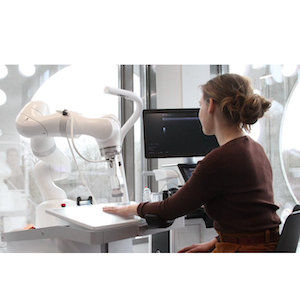
Aug. 26, 2026 — ROPCA, a Danish medtech company developing robotic and AI-powered solutions for musculoskeletal ultrasound, has received U.S. Food and Drug Administration (FDA) 510(k) clearance for Arthur, an AI-powered, fully autonomous ultrasound robot, and ROPCA's AI software Diana, marking a major milestone in the company’s expansion into the U.S. healthcare market.
CE-marked since 2022, Arthur builds on several years of clinical experience across six European countries, with more than 5,400 scans and 83,500 joints scanned to date. The FDA clearance marks the next step in bringing ROPCA’s ultrasound automation technology to specialist clinical teams in the United States.
Musculoskeletal Ultrasound Scans
Arthur performs standardized musculoskeletal ultrasound scans, while Diana analyzes the images and supports automated report generation. Together, they create an end-to-end workflow that combines consistent image acquisition with AI-assisted analysis and reporting, while keeping clinical decisions in the hands of healthcare professionals.
“FDA 510(k) clearance for Arthur and Diana is a defining moment for ROPCA. Arthur, our Arthritis Ultrasound Robot, is designed to automatically capture ultrasound images of finger, hand and wrist joints under healthcare-professional supervision — opening a new model for scalable musculoskeletal diagnostics. For providers, it can help address capacity and consistency; for patients, it points toward faster access to specialist assessment. We are now ready to build the U.S. clinical and commercial partnerships that take this new category forward.” said Johannes Schaeferhoff, CEO of ROPCA.
The clearance comes as U.S. rheumatology faces growing capacity challenges. According to the American College of Rheumatology, 72% of U.S. counties do not have a single rheumatologist,1 while workforce projections point to a significant gap between the supply of and demand for adult rheumatologists by 2030.2
“Arthur brings something particularly valuable to rheumatology: the ability to obtain standardized, reproducible ultrasound assessments of joints autonomously and efficiently. As demand for rheumatologic care grows faster than our specialist workforce, technologies like Arthur have the potential to expand access to objective imaging, increase clinical capacity, and help rheumatologists deliver more efficient and consistent care to patients with inflammatory arthritis. At the Mayo Clinic, we have had the privilege to utilize this first-in-kind technology in the research space and look forward to the opportunity of bringing it into the clinical practice,” said Matthew J. Koster, MD Associate Professor of Medicine, Division of Rheumatology Mayo Clinic, Rochester, MN, USA
Until now, ROPCA’s presence in the United States has focused on research and clinical validation. With FDA 510(k) clearance, the company can now take the next step toward making Arthur and Diana available to healthcare providers across the United States
References:
- American College of Rheumatology, June 2, 2026. American College of Rheumatology Visits Capitol Hill to Advocate for Policies to Protect and Support Patient Access to Care. https://rheumatology.org/press-releases/american-college-of-rheumatology-visits-capitol-hill-to-advocate-forpolicies-to-protect-and-support-patient-access-to-care
- American College of Rheumatology, workforce projections. By 2030, projected demand for adult rheumatologists is 8,184 clinical FTEs, compared with a projected supply of 3,455, representing a projected shortfall of 4,72 https://rheumatology.org/api/asset/blt7bda9ef568ff8a9f

 October 02, 2026