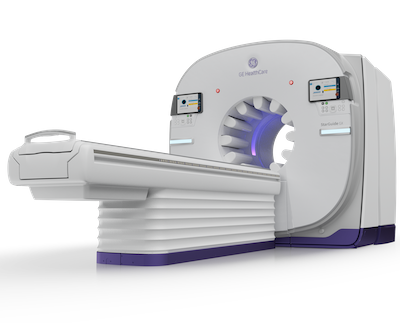
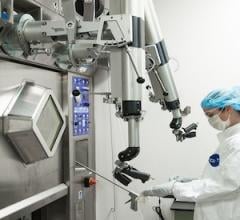
StarGuide GX 4D SPECT/CT (Photo: GE HealthCare)
Sept. 08, 2026 — GE HealthCare has announced that StarGuide GX1, its digital 4D CZT SPECT/CT technology, is 510(k) pending with the U.S. Food and Drug Administration (FDA). Building on the system’s recent CE mark, this is a step toward expanding access to advanced molecular imaging technologies in the United States and marks a significant moment in molecular imaging’s evolution — aiming to empower clinicians with a high-performance, general purpose scanner to help personalize care across a growing range of nuclear medicine applications and tracers, including the acquisition of alpha emitters.
“We are seeing a meaningful evolution in precision care, driven in large part by the continued growth of theranostics and the integration of imaging and targeted therapies,” said Prof. Ken Herrmann, Chair, Department of Nuclear Medicine, University Hospital Essen. “As new tracers — including the anticipated development of alpha-emitting agents — expand what’s possible in diagnosis and treatment, it is essential that imaging technology evolves alongside them. Having systems that can accurately capture, quantify and support these advances will be critical to enabling more personalized care and improving patient outcomes.”
Momentum is growing in nuclear medicine, driven by a developing pipeline of radioligand therapies poised to reshape the field. Increasing clinical and research interest in alpha-emitting isotopes, such as Actinium-225, Lead 212 and others for highly targeted cancer treatment2, offer the potential for greater precision by delivering high-energy radiation over short distances to help minimize damage to surrounding healthy tissue3. As this pipeline expands, the ability to accurately image and quantify alpha emitters is anticipated to become increasingly important – not only to support therapy planning and dosimetry, but also to monitor treatment response and advance clinical research4.
This shift highlights the potential value of imaging technologies like StarGuide GX, which is designed to deliver the sensitivity, flexibility and energy range expected to be important for keeping pace with emerging tracers. Designed for versatility, the system can image across a broad spectrum of energy levels — supporting both general-purpose SPECT imaging and investigational radioligand therapy isotopes — aiming to enable clinicians and researchers to explore new diagnostic and therapeutic pathways while maintaining exceptional image clarity and quantitation critical for treatment planning and monitoring.
“StarGuide GX reflects the future of nuclear medicine, where flexibility, speed and quantitative accuracy are essential,” said Erez Levy, Executive Director, Molecular Imaging, GE HealthCare. “It is designed to act as an all-in-one system and support advanced imaging techniques and emerging tracers, aiming to provide a powerful tool for clinicians looking to expand clinical capabilities and deliver personalized care.”
Powered by GE HealthCare’s patented dual-sided cadmium zinc telluride (CZT) detector technology, StarGuide GX is designed to deliver double volume sensitivity5 and maintain high-resolution imaging, enabling clinicians to capture more information with shorter scan times. The system also incorporates NVIDIA RTX computing to help optimize image reconstruction and accelerate time to results.
Additionally, the system’s patented dual-collimator detector is designed to enable collimator exchange in less than three seconds, aiming to streamline workflows by shortening traditional collimator exchange procedures. StarGuide GX’s automatic collimator exchange also aims to eliminate the need for multiple collimators and carts as well as the space required for storage.
FDA and CE Approvals
“At GE HealthCare, we are committed to bold, intentional innovation that anticipates where healthcare is going — and equips clinicians with the technology they need to get there,” said Jean-Luc Procaccini, president and CEO, Molecular Imaging and Computed Tomography, GE HealthCare. “With StarGuide GX now 510(k) pending in the U.S. and CE Marked in Europe, we are advancing a new generation of molecular imaging technologies designed to support the growth of theranostics and precision care, aiming to help clinicians confidently adopt new and evolving tracers, expand clinical practice and deliver more personalized care to every patient.”
For more information on GE HealthCare’s molecular imaging portfolio, visit gehealthcare.com.
References
-
StarGuide GX is CE marked and 510(k) pending with the U.S. FDA. Available for sale in EU member states. Not approved or cleared by the U.S. FDA. Not available for sale in the United States and other non-EU member state countries.
-
Targeted alpha therapy development and growing clinical interest: Journal of Nuclear Medicine Technology; ScienceDirect review on Actinium-225 applications.
-
Innovation News Network, “TRIUMF and Actinium-225: The world’s rarest drug.”
-
Nature Scientific Reports; Wiley International Journal of Imaging Systems and Technology – imaging and dosimetry importance for alpha emitters.
-
StarGuide GX with Low-Medium collimator has up to 2.67x increase in System Volume Sensitivity as compared to NM/CT 870 DR with LEHRS collimator. Measured per NEMA NU-1 2023.
 October 06, 2026