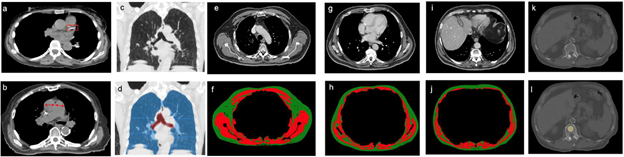
Illustration of Quantitative Analyses of CT Images.

April 15, 2022 — According to ARRS’ American Journal of Roentgenology (AJR), noncancerous imaging markers on chest CT performed before stereotactic body radiation therapy (SBRT) improve survival prediction, compared with clinical features alone.

“In patients undergoing SBRT for stage I lung cancer,” explained corresponding author and 2019 ARRS Scholar Florian J. Fintelmann, “higher coronary artery calcium (CAC) score, higher pulmonary artery (PA)-to-aorta ratio, and lower thoracic skeletal muscle index independently predicted worse overall survival.”

Fintelmann and team’s retrospective study included 282 patients (168 female, 114 male; median age, 75 years) with stage I lung cancer treated with SBRT between January 2009 and June 2017. To quantify CAC score and PA-to-aorta ratio, as well as emphysema and body composition, pretreatment chest CT was used. Associations of clinical and imaging features with overall were quantified using a multivariable Cox proportional hazards (PH) model.

For stage I lung cancer patients treated with SBRT, CAC score, PA-to-aorta ratio, and skeletal muscle index showed significant independent associations with overall survival. (p<.05). The model including clinical and imaging features demonstrated better discriminatory ability for 5-year overall survival than the model including clinical features alone (AUC 0.75 vs. 0.61, p<.01).

“The PA-to-aorta ratio, which is readily quantifiable with electronic calipers during routine image review, was the most important predictor of overall survival,” the authors of this AJR article concluded.

For more information: www.arrs.org


Related Content

News | Lung Imaging

March 11, 2026 — Noah Medical has announced the publication of the MATCH 2 study in the international, peer-reviewed ...

Time March 12, 2026
arrow
News | Stroke

March 11, 2026 — Brainomix, a provider of AI-powered imaging tools for stroke and lung fibrosis, has announced the ...

Time March 11, 2026
arrow
News | Computed Tomography (CT)

March 5, 2026 — At ECR 2026, Royal Philips introduced Rembra, its next-generation radiology CT system designed for the ...

Time March 09, 2026
arrow
Feature | Artificial Intelligence | Kyle Hardner

Once considered an adjunct brain cancer therapy and a last-resort treatment, noninvasive radiosurgery has evolved ...

Time March 09, 2026
arrow
News | Radiation Oncology

March 4, 2026 — Lunit has announced that 21 studies featuring its AI solutions will be presented at the European ...

Time March 05, 2026
arrow
News | Artificial Intelligence

March 2, 2026 — RadNet, Inc. has acquired Gleamer SAS, a radiology AI company based in Paris, France. Gleamer will be ...

Time March 03, 2026
arrow
News | Ultrasound Imaging

March 2, 2026 — Esaote Group will officially launch the new MyLab E85 and MyLab C30 GTS Edition ultrasound systems at ...

Time March 02, 2026
arrow
News | Remote Viewing Systems

Feb. 26, 2026 — DeepHealth, Inc., a provider of AI-powered health informatics and a wholly owned subsidiary of RadNet ...

Time February 27, 2026
arrow
News | FDA

Feb. 26, 2026 — The U.S. Food and Drug Administration (FDA) has given 510(k) class II clearance of qXR-Detect, the ...

Time February 26, 2026
arrow
News | Magnetic Resonance Imaging (MRI)

Feb. 9, 2026 — MRIguidance, a MedTech company developing BoneMRI, a radiation-free bone imaging solution, has appointed ...

Time February 09, 2026
arrow
Subscribe Now