December 19, 2012 — Three studies presented at the 98th annual meeting of the Radiological Society of North America (RSNA) in November reported that using bone suppression and computer-aided detection (CAD) software significantly improves the detection of lung nodules on chest X-ray images.
The research also found CAD performed well on images captured by both portable and upright X-ray machines, and that most false positive marks – the marking of areas on the chest X-ray that are not lung nodules – call radiologists' attention to other important abnormalities, including serious lung diseases, and to medical devices in or on the chest that radiologists would be able to quickly dismiss. Riverain Technologies’ ClearRead software was used in each of the studies.
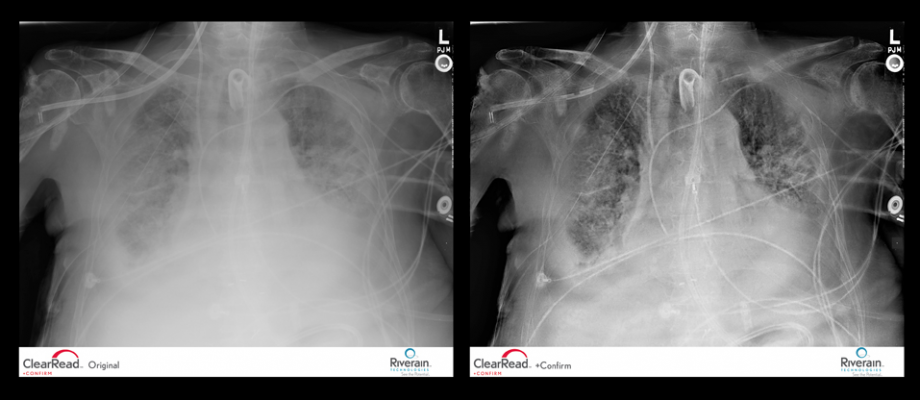
ClearRead software suppresses the ribs and clavicles on conventional chest X-ray images, providing radiologists with a clear, unobstructed view of the lungs and exposing abnormalities that might indicate disease. The software is easy to install and adopt, requiring no additional imaging equipment or staffing, and no additional radiation exposure to patients. It can be used to immediately enhance images produced by all X-ray machines throughout a hospital or health system.
In a study at Radbound University Nijmegen Medical Center (RUNMC) in the Netherlands, five attending radiologists and three radiology residents who were not experienced with the Riverain software detected more confirmed lung nodules using ClearRead Bone Suppression 2.4 software than when they evaluated the X-ray images on their own.
The radiologists read 300 chest X-ray images with and without bone suppression (111 X-rays with solitary lung nodules and 189 control cases with no nodules). They detected 79 percent of the lung nodules with bone suppression, with approximately 0.3 false positive per image compared to 71 percent detection of lung nodules and 0.21 false positive per image when they reviewed the X-rays on their own.
“The detection of hard-to-find nodules classified as ‘moderately subtle’ and ‘subtle’ was especially improved,” said Steven Schalekamp, M.D., a Ph.D. student in the department of radiology at RUNMC. “The radiologists using the bone suppression software found 26 percent of the lung nodules that were missed entirely on conventional X-ray images.”
In a separate RUNMC study involving 300 X-rays and eight readers, the radiologists’ performance also improved when they read the images using ClearRead +Detect 5.2, which circles suspected lung nodules on bone-suppressed X-ray images. The radiologists accurately detected 79 percent of 111 lung nodules with CAD, versus 73 percent when reviewing the bone-suppressed image without CAD.
The radiologists' false positive rate per image was 0.28 when they used CAD and bone suppression together, and 0.23 when they used bone suppression without CAD. ClearRead +Detect found more than half of the nodules that were missed by the radiologists.
For more information: www.riveraintech.com

 October 08, 2026