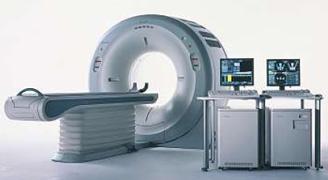
March 8, 2011 – During treatment planning, standard-bore computed tomography (CT) systems often constrain patient positioning because the bore and scan field-of-view cannot accommodate a patient positioned off-center. For this reason, the Cancer Care Center at Great River Medical Center in West Burlington, Iowa, is using Toshiba’s Aquilion Large Bore CT system to minimize the constraints on its treatment plans.
The system helps Great River Medical Center treat breast, prostate and colon cancer patients, and enables physicians to treat patients with intensity-modulated radiotherapy (IMRT). The system’s large bore allows more positioning options for patients, enabling therapists to capture the studies needed to optimally treat all patients.
“The Aquilion Large Bore’s superior image quality and large field-of-view help improve treatment plans by accurately identifying the target treatment area, improving patient safety by ensuring healthy tissue is spared unnecessary radiation,” said William McGinnis, M.D., medical director, Great River Medical Center Cancer Care Center. “In addition, the design and features of the Aquilion Large Bore allow us to better accommodate bariatric patients, many of whom were previously sent to other facilities for radiation oncology treatment. The Aquilion’s wide bore opening enables us to comfortably and safely treat these patients while obtaining high-quality images, regardless of the patient’s size or position.”
A recent study demonstrated the importance of using a CT system with a large field-of-view for radiation therapy treatment planning. The study found that 28 percent of patients did not fit within a 50 cm standard field-of-view. To provide a workaround to this limitation, most vendors developed a feature called an “extrapolated field-of-view” that extends the viewable area, but at the cost of significant image distortion. Treatment planning errors can result from the use of extrapolation, and they could be eliminated for 98 percent of patients on a system with a 70 cm acquired field-of-view.
The Aquilion Large Bore has the industry’s largest bore opening, 90 cm, with a 70 cm acquired field-of-view, making it possible to image patients of nearly all sizes.
“The larger data collection area of the Aquilion Large Bore system prevents clinicians from having to compromise when planning for radiation therapy,” said Earl Nixon, radiation therapy physicist, Great River Medical Center. “With a significant portion of our patients needing to be positioned for breast and pelvic imaging, we are able to image them in the preferred treatment position, critical for accurate radiation therapy dose calculations.”
For more information: www.medical.toshiba.com

 October 08, 2026