October 12, 2011 — GE Healthcare showcased a number of new radiation oncology tools at the 53rd annual American Society for Radiation Oncology (ASTRO) meeting in Miami Beach, Fla., Oct. 2-6.
MD Connect
Recent advances in oncology imaging and targeted therapies have made it possible to treat cancer more effectively. More precise and targeted treatment, coupled with earlier detection, has led to an improvement in five-year, disease-free survival rates for cancer patients.
Yet, these new technologies generate more sophisticated and detailed information that is used throughout the care cycle. For caregivers and clinicians, this translates to a more complex workflow for processing, connecting, and collaborating across the continuum of oncology care.
MD Connect is a thin client solution designed for oncology that addresses the need for seamless workflow. It provides fast access to a complete portfolio of applications, via virtually any networked computer. These applications include sophisticated tools for virtual simulation, 3-D image fusion and 4-D motion management, as well as tools to stage and monitor treatment effectiveness.
The system also integrates with the Eclipse treatment planning platform from Varian Medical Systems, all on one desktop, as well as other DICOM based treatment planning platforms. Compliant with the IHE-RO standard, MD Connect interoperates across a multitude of different oncology systems and manufacturers.
New RT Simulation CT systems
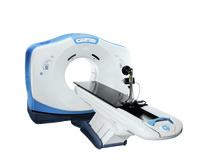
GE’s new wide bore RT portfolio—including the Discovery CT590 RT (radiotherapy) and Optima CT580 RT—enhances accuracy, enhanced visualization, complex patient positioning and monitoring with productive workflow. These computed tomography (CT) systems are designed specifically with treatment planning in mind and help physicians address increasingly specialized imaging needs.
Built from the ground up and flexible in a variety of radiation oncology settings, the systems are powered by the latest in GE CT technology. For example, the Discovery CT590 RT offers an automated 4-D video organ motion recording feature that captures organ movement to better adapt future radiation therapy treatments.
“As new treatment technologies emerge in RT, there is an increasing need for intuitive imaging systems supported by robust clinical applications and reliable service,” said Randy Hemingway, administrative director of radiation oncology at Washington Hospital Center in Washington, D.C. “Our new Discovery CT590 RT with Advantage 4-D and Advantage SimMD offers just such benefits—helping us improve workflow with accuracy as we seek optimal clinical outcomes that best meet our patients’ needs.”
MR Systems
GE’s magnetic resonance (MR) systems deliver the high spatial integrity required for radiation oncology with an expansive 50 cm field of view that accommodates imaging out to the edge of the skin. Built on a fully redesigned wide-bore MR platform, these systems feature advanced applications for rapid acquisition of high-resolution isotropic MR images, dynamic contrast enhanced imaging and advanced workflow. These features help physicians characterize disease, plan treatment options, target tumors, preserve healthy tissue and assess response to therapy.
Integrated with the MR Radiation Oncology Suite and GEM Suite of coils, the company’s wide-bore MR systems allow MR imaging in the treatment position for prostate, brain/head & neck and gynecological tumors; they also provide full interoperability with fusion and treatment simulation software programs.
New GEM Express patient table and posterior array
The new GEM Express patient table is a mobile patient transport with an embedded high-density, posterior radiofrequency (RF) coil array. The integrated posterior array, with uniquely sized elements, helps optimize prostate image quality. It enables clinicians to image the patient in the treatment position, without compromising image quality. It also supports both headfirst and feet-first imaging for all anatomies and can eliminate the need to reposition patients within an exam, as well as the need for coil exchanges.
For more information: www.gehealthcare.com

 October 07, 2026