

BLOG: The Power of the Next Generation of RIS
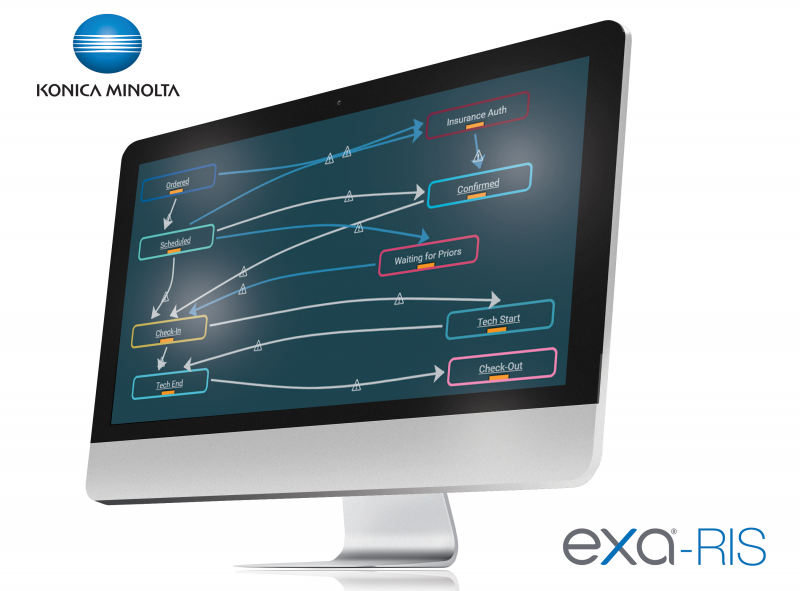
A Radiology Information System (RIS) is the engine that drives radiology workflow. That’s why Konica Minolta Healthcare has focused on developing an advanced yet customizable Workflow Design Engine for Exa, a web-based, modular platform that includes RIS, PACS, Billing, specialty viewers and enterprise imaging tools. From order creation to report delivery, Exa RIS optimizes the entire process.
“Our design engine streamlines and unites each part of the workflow to enhance patient management and maximize the productivity of the staff and equipment utilization for imaging centers and radiology practices,” said Kevin Borden, Vice President of HCIT Product at Konica Minolta Healthcare.
Exa RIS can be integrated with other modules of the Exa platform or implemented as a standalone solution. It is scalable, making it an ideal solution for both single and multi-facility enterprises and allowing practices to grow and evolve.
A Scheduling Wizard
Efficiency in workflow begins with how Exa RIS delivers “smart” scheduling. Available appointment times are displayed based on templates and criteria that are customizable by location, room, resource and exam type. It will show the next available appointment time for the location closest to the patient. A regionalization feature allows for the grouping of facilities by region, such as states, and by market, such as a city or group of cities. By default, the scheduling wizard will search within 25 miles of the patient; however, this is configurable.
“Exa was designed to drive productivity and ease of scheduling, with the goal to help imaging providers improve profitability by increasing the number of patients each facility can see each day,” explained Tim Kearns, Strategic Marketing Manager, Healthcare IT at Konica Minolta. It also translates to fewer open imaging slots and a greater return on capital equipment investments.
“An efficient RIS on the front end can help a center maximize the utilization of imaging assets. Ultimately, that really leads to better patient care and higher patient satisfaction,” Kearns added.
With Exa RIS, the staff immediately knows what’s available by time and location to determine what’s best for the patient based on his or her needs.
Exa RIS provides rules-based scheduling that accommodates resources, such as associating modalities with appointment types and technologists. For example, MRI exams can be scheduled only when an MR-certified technologist is working. Logic can also be built to manage time slots for modality rooms — if one technologist is working several rooms during a shift, an autoblocking capability limits exam capacity. Conversely, if more technologists are staffed during a particular time of the day, Exa RIS will open up more time slots.
Scalability and customization are other key features of Exa RIS. It has the capability to accommodate thousands of concurrent users across disparate sites or several users at one location. Customizable automations based on study status and alerts give the staff the information they need to easily, quickly and successfully schedule the patient exam.
Customized Workflow Engine
As a fully web-based software solution, the Exa platform can be configured with one or more modules — RIS, PACS and Billing. Regardless of which modules the site selects, a single integrated database unifies the patient chart. Whenever a change is made to a patient or exam record, the updated information is automatically reflected across the entire platform.
“With Exa, RIS and PACS work together as one application for a seamless end-to-end workflow,” Borden continued. “That is where our customers really reap the benefits. It’s a one-stop shop from scheduling, to patient check in, to opening up images, reading the study, and delivering report results to referring physicians and patients.”
Exa RIS’s embedded Custom Workflow Engine allows the administrator to create different workflows for virtually any conceivable requirement based on study status. Implementing different validation options for each study status is possible, ensuring the required information is captured at the appropriate point in the workflow.
“A document management module in Exa RIS allows the user to easily create orders and manage custom work queues for staff,” explained Jessica Rader, RIS Product Manager for Konica Minolta. “We also have the ability to receive and annotate inbound electronic faxes or document that can then be routed to specific departments, users or queues, and then sent directly to the patient chart or relevant order. So, if a physician's requisition comes in via fax, the staff can seamlessly create that order and then attach the document to it.”
The combination of a customizable workflow engine and an efficient scheduling solution leads to improved productivity, profitability and patient satisfaction.
“These capabilities will help improve overall patient satisfaction with an efficient schedule and clinical workflow, so you can accommodate the maximum number of patients each day and drive productivity,” said Borden. “Happy patients are return customers, and that helps build the bottom line.”
Editor's note: This blog concludes the series from Konica Minolta on technical innovation. The first, BLOG: Zero-footprint Viewer with Server-side Rendering Pushes Imaging Forward During Pandemic, can be read here. The second, BLOG: Exa Gateway Offers a New Way to Deliver Teleradiology, can be read here. The third, BLOG: Artificial Intelligence for Clinical Decision Support and Increased Revenues, can be found here.
Related Content

News | Artificial Intelligence
Oct. 7, 2026 – CARPL.ai has announced a collaboration with HOPPR that will give healthcare providers access to HOPPR's ...
 October 08, 2026

Feature | Digital Pathology | Kyle Hardner
As recently as a decade ago, pathology technology was expected to become more expensive, larger and more precise. Yet in ...
October 02, 2026 
News | ASTRO
Sept. 29, 2026 — The American Society for Radiation Oncology (ASTRO) has named Siemens Healthineers the inaugural ...
September 29, 2026 
News | Computed Tomography (CT)
Sept. 17, 2026 — Royal Philips and Southwest Mississippi Regional Medical Center (SMRMC), which serves as the hub of ...
September 24, 2026 
News | Radiology Education
Sept. 16, 2026 — As urgent care centers and outpatient healthcare facilities expand their use of diagnostic imaging, the ...
September 17, 2026 
News | PET Imaging
Sept. 10, 2026 — Siemens Healthineers Molecular Imaging has completed a $43.6 million construction and renovation ...
September 14, 2026 
Feature | Artificial Intelligence | Kyle Hardner
A radiologist pulls up a chest CT scan flagged for a pulmonary nodule. One artificial intelligence (AI) tool writes its ...
September 09, 2026 
News | Radiology Business
August 18, 2026 – NewVue, a provider of cloud-native software that unifies how radiologists work while improving ...
August 25, 2026 
Feature | Artificial Intelligence | Madhu Jahagirdar
Radiologists spend much of their day moving between different systems: One application to review images. Another to ...
August 17, 2026 
News | X-Ray
Aug. 10, 2026 — Teledyne Technologies Inc. and Varex Imaging Corp. have jointly announced that they have entered into a ...
August 14, 2026 © Copyright Wainscot Media. All Rights Reserved.

Subscribe Now